
Join Our JEE Preparation Group
Prep with like-minded aspirants; Get access to free daily tests and study material.
Sign in
Please select an account to continue using cracku.in
↓ →
Join Our JEE Preparation Group
Prep with like-minded aspirants; Get access to free daily tests and study material.
An incompressible liquid is kept in a container having a weightless piston with a hole. A capillary tube of inner radius 0.1 mm is dipped vertically into the liquid through the airtight piston hole, as shown in the figure. The air in the container is isothermally compressed from its original volume $$V_0$$ to $$\frac{100}{101}V_0$$ with the movable piston. Considering air as an ideal gas, the height ($$h$$) of the liquid column in the capillary above the liquid level in cm is ____.
[Given: Surface tension of the liquid is 0.075 Nm$$^{-1}$$, atmospheric pressure is $$10^5$$ N m$$^{-2}$$, acceleration due to gravity (g) is 10 m s$$^{-2}$$, density of the liquid is $$10^3$$ kg m$$^{-3}$$ and contact angle of capillary surface with the liquid is zero]
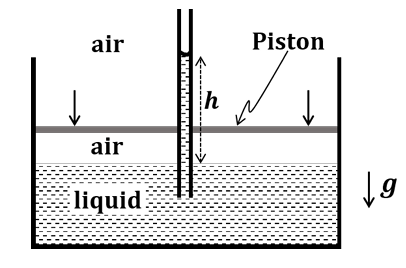
Correct Answer: 25
Initially the air above the liquid is at atmospheric pressure $$P_0 = 10^{5}\,\text{N m}^{-2}$$ and has volume $$V_0$$. When the air isothermally compressed to $$\dfrac{100}{101}V_0$$, the ideal-gas relation $$P V = \text{constant}$$ gives
$$P_1 V_1 = P_0 V_0 \quad\Rightarrow\quad P_1 = P_0\dfrac{V_0}{V_1} = P_0\dfrac{V_0}{\dfrac{100}{101}V_0} = P_0 \dfrac{101}{100}$$
Hence the air pressure inside the container becomes
$$P_1 = \dfrac{101}{100}\,P_0 = \dfrac{101}{100}\,(10^{5}) = 1.01\times10^{5}\,\text{Pa}$$
The top of the capillary tube is open to the atmosphere, so the air pressure above the meniscus is still $$P_0$$. Let $$h$$ be the height of the liquid column that rises in the capillary, and $$r$$ the inner radius of the tube.
Across a concave meniscus (contact angle $$\theta = 0^\circ$$), the Laplace pressure difference is $$\Delta P = \dfrac{2T\cos\theta}{r} = \dfrac{2T}{r}$$.
Pressure just below the meniscus inside the liquid: $$P_\text{liq} = P_0 - \dfrac{2T}{r}$$ (pressure is lower in the liquid for a concave surface)
Pressure at the base of the capillary (same level as the reservoir surface): $$P_\text{base} = P_\text{liq} + \rho g h$$
This pressure must equal the air pressure on the free surface inside the container, $$P_1$$. Therefore,
$$P_1 = \left(P_0 - \dfrac{2T}{r}\right) + \rho g h$$
Solving for $$h$$:
$$h = \dfrac{P_1 - P_0 + \dfrac{2T}{r}}{\rho g}$$
Substituting the given data $$T = 0.075\,\text{N m}^{-1}, \; r = 0.1\,\text{mm} = 1\times10^{-4}\,\text{m},$$ $$\rho = 10^{3}\,\text{kg m}^{-3}, \; g = 10\,\text{m s}^{-2},$$ and $$P_1 - P_0 = 1.01\times10^{5} - 1.00\times10^{5} = 1.0\times10^{3}\,\text{Pa},$$ we obtain
$$\dfrac{2T}{r} = \dfrac{2\,(0.075)}{1\times10^{-4}} = 1.5\times10^{3}\,\text{Pa}$$
$$h = \dfrac{1.0\times10^{3} + 1.5\times10^{3}}{(10^{3})(10)} = \dfrac{2.5\times10^{3}}{1.0\times10^{4}} = 0.25\,\text{m}$$
Converting to centimetres, $$h = 0.25\,\text{m} = 25\,\text{cm}$$
Hence, the height of the liquid column in the capillary is 25 cm.
Was this solution helpful?
Create a FREE account and get:
_1.webp)

Educational materials for JEE preparation

Ask our AI anything

AI can make mistakes. Please verify important information.
AI can make mistakes. Please verify important information.
