
Join Our JEE Preparation Group
Prep with like-minded aspirants; Get access to free daily tests and study material.
Sign in
Please select an account to continue using cracku.in
↓ →
Join Our JEE Preparation Group
Prep with like-minded aspirants; Get access to free daily tests and study material.
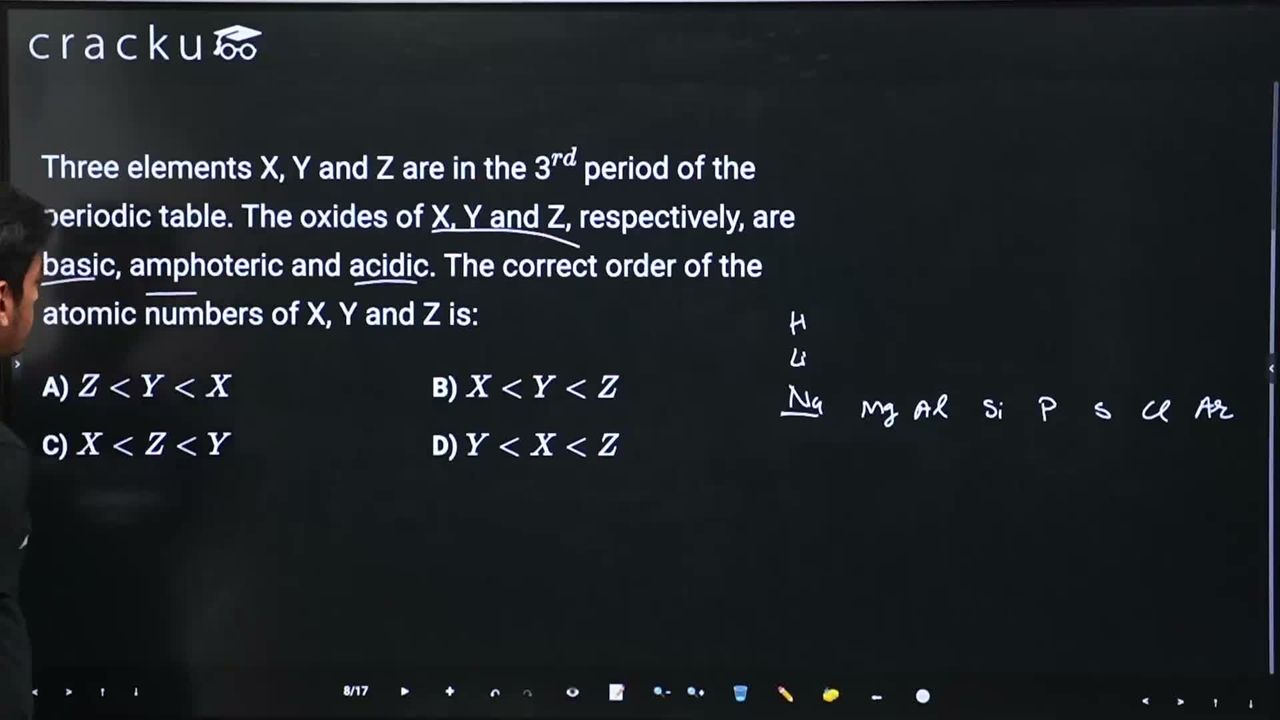
Three elements X, Y and Z are in the 3$$^{rd}$$ period of the periodic table. The oxides of X, Y and Z, respectively, are basic, amphoteric and acidic. The correct order of the atomic numbers of X, Y and Z is:
In the modern periodic table, elements of the 3rd period appear in the horizontal sequence from sodium (Na, atomic number 11) to argon (Ar, atomic number 18). Moving from left to right across a period, the metallic character of the elements decreases, while the non-metallic character increases. This gradual change in character is directly reflected in the nature of their oxides.
We recall the general trend:
$$\text{Metallic character}\;\downarrow \quad\Longrightarrow\quad \text{Basic nature of oxide}\;\downarrow \quad\text{and}\quad \text{Acidic nature of oxide}\;\uparrow$$
So, as we progress from the metallic left side to the non-metallic right side of a period:
$$\text{Strongly basic oxides} \;\longrightarrow\; \text{Amphoteric oxides} \;\longrightarrow\; \text{Strongly acidic oxides}$$
Listing the 3rd-period elements with the nature of their important oxides:
$$ \begin{aligned} \text{Na (11)} & : \text{Na}_2\text{O} \;-\; \text{strongly basic} \\ \text{Mg (12)} & : \text{MgO} \;-\; \text{basic} \\ \text{Al (13)} & : \text{Al}_2\text{O}_3 \;-\; \text{amphoteric} \\ \text{Si (14)} & : \text{SiO}_2 \;-\; \text{weakly acidic} \\ \text{P (15)} & : \text{P}_4\text{O}_{10} \;-\; \text{acidic} \\ \text{S (16)} & : \text{SO}_3 \;-\; \text{acidic} \\ \text{Cl (17)} & : \text{Cl}_2\text{O}_7 \;-\; \text{strongly acidic} \\ \end{aligned} $$
From the question, the oxide of element X is basic, the oxide of Y is amphoteric, and the oxide of Z is acidic. Matching these descriptions with the list above:
• A basic oxide corresponds to an element like Na (11) or Mg (12).
• The only amphoteric oxide in this period is Al2O3, so Y must be Al (atomic number 13).
• Acidic oxides begin with SiO2 (Si, 14) and become more acidic as we go further right. Any of Si, P, S, or Cl satisfies “acidic”.
For the atomic numbers to satisfy X < Y < Z, we simply pick the first basic element to the left of Al and the first acidic element to the right of Al. The smallest such set is:
$$ X = \text{Mg}\;(12),\quad Y = \text{Al}\;(13),\quad Z = \text{Si}\;(14). $$
This clearly gives:
$$X < Y < Z.$$
Among the options, this inequality matches Option B.
Hence, the correct answer is Option B.
Was this solution helpful?
Click on the Email ☝️ to Watch the Video Solution
Create a FREE account and get:
_1.webp)

Educational materials for JEE preparation

Ask our AI anything

AI can make mistakes. Please verify important information.
AI can make mistakes. Please verify important information.


