
Join Our JEE Preparation Group
Prep with like-minded aspirants; Get access to free daily tests and study material.
Sign in
Please select an account to continue using cracku.in
↓ →
Join Our JEE Preparation Group
Prep with like-minded aspirants; Get access to free daily tests and study material.
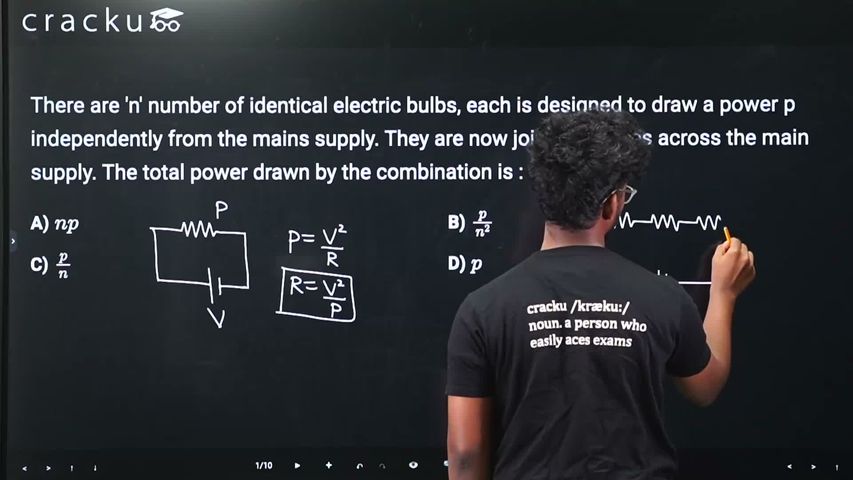
There are 'n' number of identical electric bulbs, each is designed to draw a power p independently from the mains supply. They are now joined in series across the main supply. The total power drawn by the combination is :
Let the mains supply voltage be $$V$$ (same for every bulb).
Each identical bulb is rated to consume power $$p$$ when connected alone across the mains.
For a resistor-type load the power relation is
$$p = \frac{V^{2}}{R} \; -(1)$$
where $$R$$ is the resistance of one bulb.
From $$(1)$$, the resistance of each bulb is
$$R = \frac{V^{2}}{p} \; -(2)$$
When the $$n$$ bulbs are connected in SERIES, their resistances add up:
$$R_{\text{series}} = nR = n \left(\frac{V^{2}}{p}\right) = \frac{nV^{2}}{p} \; -(3)$$
The current drawn from the mains is given by Ohm’s law:
$$I = \frac{V}{R_{\text{series}}} = \frac{V}{\dfrac{nV^{2}}{p}} = \frac{p}{nV} \; -(4)$$
The total power taken from the mains by the series combination is
$$P_{\text{total}} = I^{2} R_{\text{series}}$$
Substituting from $$(4)$$ and $$(3)$$:
$$P_{\text{total}} = \left(\frac{p}{nV}\right)^{2} \times \frac{nV^{2}}{p}$$
$$\quad = \frac{p^{2}}{n^{2}V^{2}} \times \frac{nV^{2}}{p}$$
$$\quad = \frac{p}{n}$$
Hence the total power drawn by the $$n$$ bulbs in series is $$\dfrac{p}{n}$$.
Option C is correct.
Was this solution helpful?
Click on the Email ☝️ to Watch the Video Solution
Create a FREE account and get:
_1.webp)

Educational materials for JEE preparation

Ask our AI anything

AI can make mistakes. Please verify important information.
AI can make mistakes. Please verify important information.
