
Join Our JEE Preparation Group
Prep with like-minded aspirants; Get access to free daily tests and study material.
Sign in
Please select an account to continue using cracku.in
↓ →
Join Our JEE Preparation Group
Prep with like-minded aspirants; Get access to free daily tests and study material.
First, let us recall the two kinds of thermochemical quantities involved here.
1. Ionisation enthalpy (also called ionisation energy) is the energy required to remove an electron from an isolated gaseous atom:
$$X_{(g)} \to X^+_{(g)} + e^-$$
Because energy has to be supplied, ionisation enthalpy is always positive; hence every ionisation process is endothermic.
2. Electron-gain enthalpy (also called electron affinity) is the energy change when an electron is added to an isolated gaseous species:
$$Y_{(g)} + e^- \to Y^-_{(g)}$$
If energy is released, the enthalpy change is negative and the process is exothermic. If energy has to be supplied (positive enthalpy change) the process is endothermic.
With this information we now examine the four options one by one.
Option A: $$Ar_{(g)} + e^- \to Ar^-_{(g)}$$
Argon is a noble-gas atom with a completely filled octet. Adding an extra electron would place it in a new, higher-energy shell, so energy must be supplied. Therefore the electron-gain enthalpy of Ar is positive; the process is endothermic.
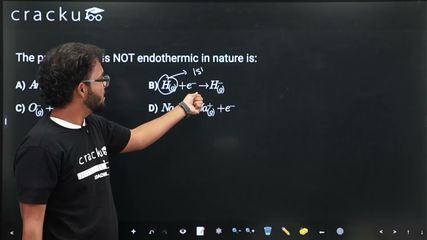
Option B: $$H_{(g)} + e^- \to H^-_{(g)}$$
Hydrogen has the electronic configuration $$1s^1$$. On taking one more electron it attains the stable helium-like configuration $$1s^2$$. The system releases energy in doing so; hence the electron-gain enthalpy of hydrogen is negative. Because energy is released, this process is exothermic, i.e. it is not endothermic.
Option C: $$O^-_{(g)} + e^- \to O^{2-}_{(g)}$$
The anion $$O^-$$ already carries a negative charge. Introducing a second electron increases electron-electron repulsion markedly, so extra energy must be supplied. Thus the second electron-gain enthalpy of oxygen is positive; the process is endothermic.
Option D: $$Na_{(g)} \to Na^+_{(g)} + e^-$$
This is the first ionisation of sodium. As stated earlier, every ionisation requires energy input, so the process is endothermic.
Summarising, Options A, C and D are endothermic, whereas Option B releases energy and is not endothermic.
Hence, the correct answer is Option B.
Was this solution helpful?
Click on the Email ☝️ to Watch the Video Solution
Create a FREE account and get:
_1.webp)

Educational materials for JEE preparation

Ask our AI anything

AI can make mistakes. Please verify important information.
AI can make mistakes. Please verify important information.


