
Join Our JEE Preparation Group
Prep with like-minded aspirants; Get access to free daily tests and study material.
Sign in
Please select an account to continue using cracku.in
↓ →
Join Our JEE Preparation Group
Prep with like-minded aspirants; Get access to free daily tests and study material.
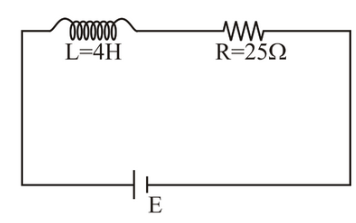
In the given figure, an inductor and resistor are connected in series with a battery of emf $$E$$ volt. $$\frac{E^a}{2b}$$ J s$$^{-1}$$ represents the maximum rate at which the energy is stored in the magnetic field (inductor). The numerical value of $$\frac{b}{a}$$ will be _____.
Correct Answer: 25
In a series $$RL$$ circuit connected to a battery of emf $$E$$, the energy $$U$$ stored in the magnetic field of the inductor is given by: $$U = \frac{1}{2} L i^2$$
The rate of energy storage ($$P_L$$) is the time derivative of the stored energy. $$P_L = \frac{dU}{dt} = \frac{d}{dt} \left( \frac{1}{2} L i^2 \right) = L i \frac{di}{dt}$$
From KVL for the loop, $$E = iR + L \frac{di}{dt} \implies L \frac{di}{dt} = E - iR$$
$$P_L = i(E - iR) = Ei - i^2R$$
To find the maximum rate, we differentiate $$P_L$$ with respect to the current $$i$$ and set it to zero.
$$\frac{dP_L}{di} = E - 2iR = 0 \implies i = \frac{E}{2R}$$
$$P_{L, \text{max}} = E \left( \frac{E}{2R} \right) - \left( \frac{E}{2R} \right)^2 R = \frac{E^2}{2R} - \frac{E^2}{4R}$$
$$P_{L, \text{max}} = \frac{E^2}{4R}$$
$$P_{L, \text{max}} = \frac{E^2}{4 \times 25} = \frac{E^2}{100}$$
$$\frac{E^2}{100} = \frac{E^a}{2b}$$
$$\frac{b}{a} = \frac{50}{2} = \mathbf{25}$$
Was this solution helpful?
Create a FREE account and get:
_1.webp)

Educational materials for JEE preparation

Ask our AI anything

AI can make mistakes. Please verify important information.
AI can make mistakes. Please verify important information.


