
Join Our JEE Preparation Group
Prep with like-minded aspirants; Get access to free daily tests and study material.
Sign in
Please select an account to continue using cracku.in
↓ →
Join Our JEE Preparation Group
Prep with like-minded aspirants; Get access to free daily tests and study material.
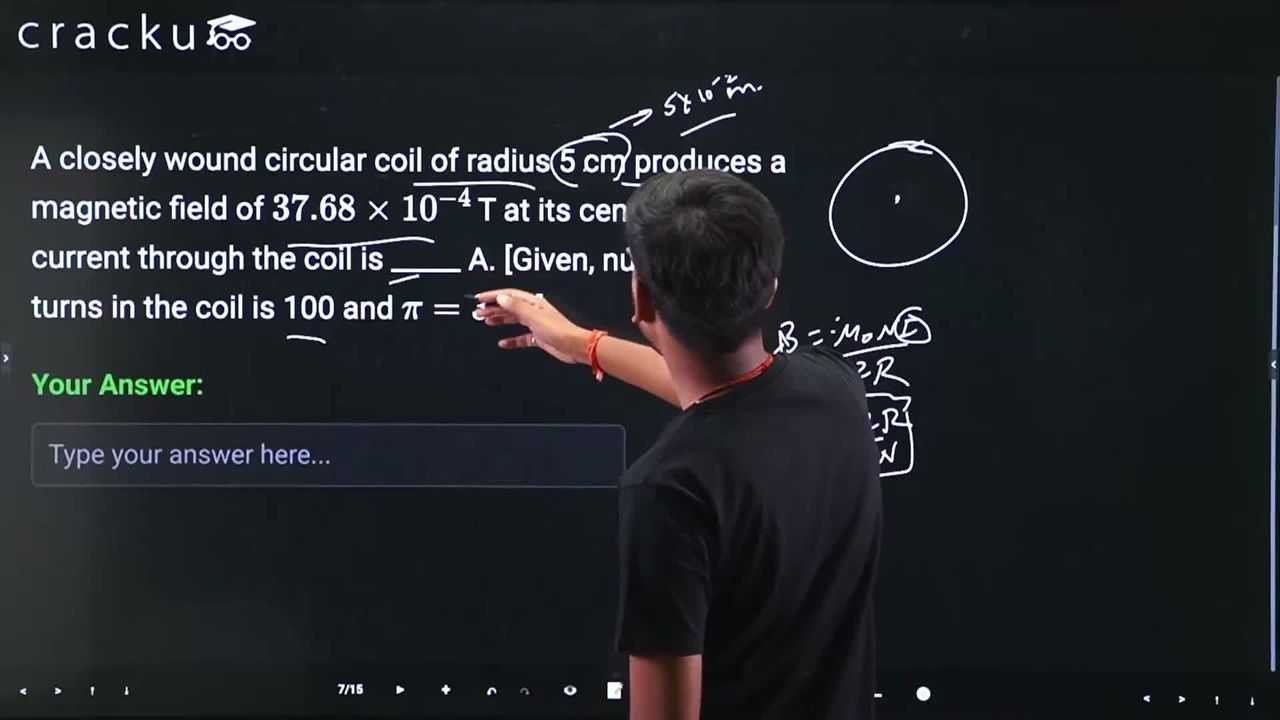
A closely wound circular coil of radius 5 cm produces a magnetic field of $$37.68 \times 10^{-4}$$ T at its center. The current through the coil is _____ A. [Given, number of turns in the coil is 100 and $$\pi = 3.14$$]
Correct Answer: 3
The magnetic field at the center of a closely wound circular coil is given by the formula:
$$ B = \frac{\mu_0 N I}{2R} $$
Here, $$ B $$ is the magnetic field, $$ \mu_0 $$ is the permeability of free space ($$ 4\pi \times 10^{-7} $$ T m/A), $$ N $$ is the number of turns, $$ I $$ is the current, and $$ R $$ is the radius of the coil.
We are given:
First, express $$ \mu_0 $$ using the given $$ \pi $$:
$$ \mu_0 = 4 \pi \times 10^{-7} = 4 \times 3.14 \times 10^{-7} = 12.56 \times 10^{-7} = 1.256 \times 10^{-6} \text{ T m/A} $$
Now, rearrange the formula to solve for $$ I $$:
$$ I = \frac{2 R B}{\mu_0 N} $$
Substitute the known values:
$$ I = \frac{2 \times 0.05 \times 37.68 \times 10^{-4}}{1.256 \times 10^{-6} \times 100} $$
Compute the numerator:
$$ 2 \times 0.05 = 0.1 $$
$$ 0.1 \times 37.68 \times 10^{-4} = 0.1 \times 0.003768 = 0.0003768 = 3.768 \times 10^{-4} $$
Compute the denominator:
$$ 1.256 \times 10^{-6} \times 100 = 1.256 \times 10^{-4} $$
Now, divide the numerator by the denominator:
$$ I = \frac{3.768 \times 10^{-4}}{1.256 \times 10^{-4}} = \frac{3.768}{1.256} $$
Perform the division:
$$ 3.768 \div 1.256 = 3 $$
Therefore, the current $$ I $$ is 3 A.
Hence, the correct answer is 3.
Click on the Email ☝️ to Watch the Video Solution
Create a FREE account and get:
_1.webp)

Educational materials for JEE preparation

Ask our AI anything

AI can make mistakes. Please verify important information.
AI can make mistakes. Please verify important information.


