
Join Our JEE Preparation Group
Prep with like-minded aspirants; Get access to free daily tests and study material.
Sign in
Please select an account to continue using cracku.in
↓ →
Join Our JEE Preparation Group
Prep with like-minded aspirants; Get access to free daily tests and study material.
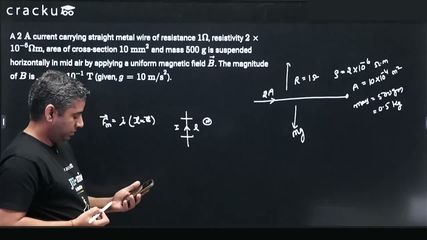
A $$2 \text{ A}$$ current carrying straight metal wire of resistance $$1\Omega$$, resistivity $$2 \times 10^{-6}\Omega\text{m}$$, area of cross-section $$10 \text{ mm}^2$$ and mass $$500 \text{ g}$$ is suspended horizontally in mid air by applying a uniform magnetic field $$\vec{B}$$. The magnitude of $$B$$ is ______ $$\times 10^{-1} \text{ T}$$ (given, $$g = 10 \text{ m/s}^2$$).
Correct Answer: 5
Given: Current $$I = 2$$ A, resistance $$R = 1\Omega$$, resistivity $$\rho = 2 \times 10^{-6} \Omega$$m, area $$A = 10$$ mm$$^2 = 10 \times 10^{-6}$$ m$$^2$$, and mass $$m = 500$$ g = 0.5 kg.
First, we find the length of the wire using the relation $$R = \frac{\rho L}{A}$$ which gives $$L = \frac{RA}{\rho} = \frac{1 \times 10 \times 10^{-6}}{2 \times 10^{-6}} = 5 \text{ m}$$.
Next, the magnetic force must balance the weight of the wire, so $$BIL = mg$$ and hence $$B = \frac{mg}{IL} = \frac{0.5 \times 10}{2 \times 5} = \frac{5}{10} = 0.5 \text{ T}$$.
Therefore, $$B = 0.5$$ T $$= 5 \times 10^{-1}$$ T.
The answer is 5.
Was this solution helpful?
Click on the Email ☝️ to Watch the Video Solution
Create a FREE account and get:
_1.webp)

Educational materials for JEE preparation

Ask our AI anything

AI can make mistakes. Please verify important information.
AI can make mistakes. Please verify important information.
