
Join Our JEE Preparation Group
Prep with like-minded aspirants; Get access to free daily tests and study material.
Sign in
Please select an account to continue using cracku.in
↓ →
Join Our JEE Preparation Group
Prep with like-minded aspirants; Get access to free daily tests and study material.
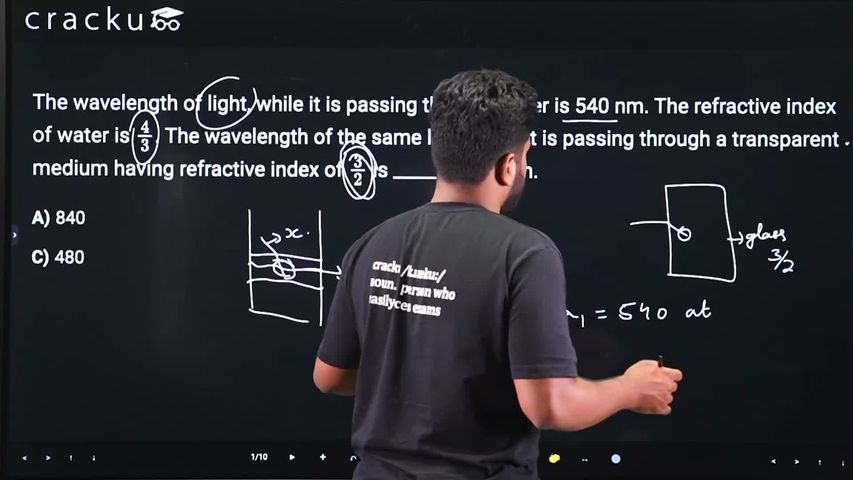
The wavelength of light, while it is passing through water is 540 nm. The refractive index of water is $$\frac{4}{3}$$. The wavelength of the same light when it is passing through a transparent medium having refractive index of $$\frac{3}{2}$$ is ____________nm.
We need to find the wavelength of light in a medium with refractive index $$\frac{3}{2}$$, given its wavelength in water. The wavelength in water is $$\lambda_w = 540$$ nm, the refractive index of water is $$n_w = \frac{4}{3}$$, and the refractive index of the new medium is $$n_m = \frac{3}{2}$$.
We begin by finding the wavelength in vacuum. The relationship between wavelength in vacuum ($$\lambda_0$$) and wavelength in a medium is:
$$\lambda_{medium} = \frac{\lambda_0}{n}$$
This follows because the speed of light in a medium is $$v = c/n$$, and since the frequency remains constant when light passes between media ($$v = f\lambda$$), we have $$\lambda_{medium} = \lambda_0 / n$$. From the wavelength in water it follows that
$$\lambda_0 = n_w \times \lambda_w = \frac{4}{3} \times 540 = 720 \text{ nm}$$
Next, the wavelength in the new medium is
$$\lambda_m = \frac{\lambda_0}{n_m} = \frac{720}{3/2} = 720 \times \frac{2}{3} = 480 \text{ nm}$$
Alternatively, using a direct ratio of wavelengths in different media:
$$\frac{\lambda_m}{\lambda_w} = \frac{n_w}{n_m} \implies \lambda_m = \lambda_w \times \frac{n_w}{n_m} = 540 \times \frac{4/3}{3/2} = 540 \times \frac{8}{9} = 480 \text{ nm}$$
The correct answer is Option 3: 480 nm.
Was this solution helpful?
Click on the Email ☝️ to Watch the Video Solution
Create a FREE account and get:
_1.webp)

Educational materials for JEE preparation

Ask our AI anything

AI can make mistakes. Please verify important information.
AI can make mistakes. Please verify important information.
