
Join Our JEE Preparation Group
Prep with like-minded aspirants; Get access to free daily tests and study material.
Sign in
Please select an account to continue using cracku.in
↓ →
Join Our JEE Preparation Group
Prep with like-minded aspirants; Get access to free daily tests and study material.
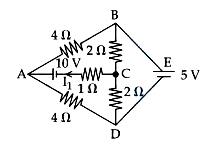
The current flowing through the $$1\Omega$$ resistor is $$\frac{n}{10}$$ A. The value of $$n$$ is ________
Correct Answer: 25
step 1: identify key nodes
Let node C be reference (0 V).
We want current through the 1 Ω resistor (between left junction and C).
step 2: simplify structure
Notice:
• B-C = 2 Ω
• D-C = 2 Ω
• A connects to B and D via 4 Ω each
• C connects to E (5 V source)
• A to C branch has: 10 V source + 1 Ω
step 3: use symmetry
The top and bottom halves (via 4Ω-2Ω and 4Ω-2Ω) are symmetric → so B and D are at same potential.
Thus currents through those two paths are equal.
So equivalent of those two paths from A to C:
Each path: 4 + 2 = 6 Ω
Two identical 6 Ω in parallel → equivalent = 3 Ω
step 4: reduced circuit
Now between A and C we have:
• one branch: 10 V source in series with 1 Ω
• another branch: 3 Ω
And C to E is just a wire with 5 V source setting potential.
step 5: set node voltages
Let C = 0 V
Then E = 5 V
Let $$A=V_A$$
step 6: currents from A to C
Branch 1 (via 3Ω):
$$I₁=V_A/3$$
Branch 2 (via 1Ω + 10V source):
Careful with polarity: from diagram, going A → C, the 10 V source gives a drop.
So:
$$I₂=(V_A−10)/1=V_A−10$$
step 7: KCL at node A
Total current leaving A = 0:
$$V_A/3+(V_A−10)=0$$
Multiply by 3:
$$V_A+3V_A−30=0$$
$$4V_A=30$$
$$V_A=7.5V$$
step 8: current through 1Ω
$$I=V_A−10=7.5−10=−2.5A$$
Magnitude = 2.5 A
step 9: match form
I = n/10
2.5 = n/10
n = 25
Was this solution helpful?
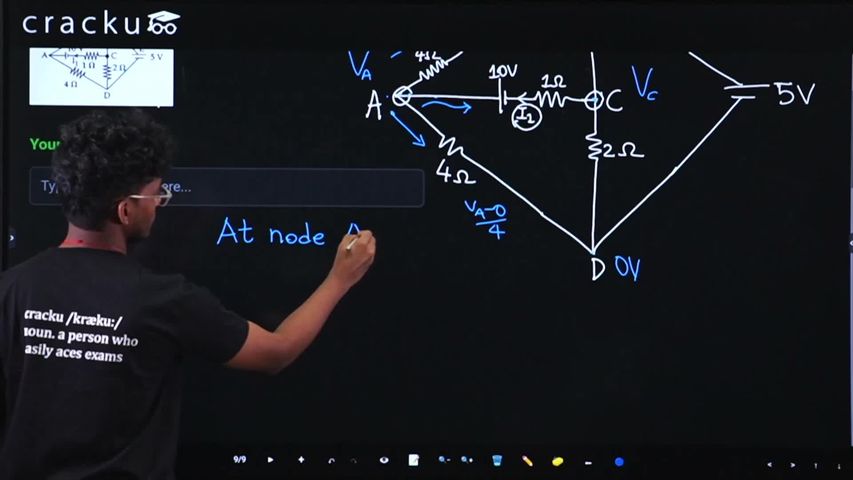
Click on the Email ☝️ to Watch the Video Solution
Create a FREE account and get:
_1.webp)

Educational materials for JEE preparation

Ask our AI anything

AI can make mistakes. Please verify important information.
AI can make mistakes. Please verify important information.
