
Join Our JEE Preparation Group
Prep with like-minded aspirants; Get access to free daily tests and study material.
Sign in
Please select an account to continue using cracku.in
↓ →
Join Our JEE Preparation Group
Prep with like-minded aspirants; Get access to free daily tests and study material.
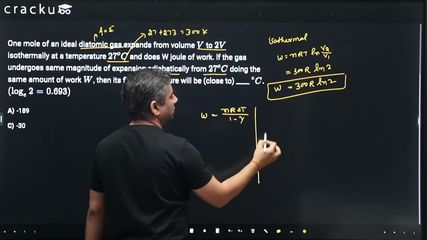
One mole of an ideal diatomic gas expands from volume $$V$$ to $$2 V$$ isothermally at a temperature $$27^{o}C$$ and does W joule of work. lf the gas undergoes same magnitude of expansion adiabatically from $$27^{o}C$$ doing the same amount of work $$W$$, then its final temperature will be (close to) ____ $$^{\circ}C.$$
$$(\log_{e}2 = 0.693)$$
We have one mole of an ideal diatomic gas. We need to compare isothermal and adiabatic expansions from volume $$V$$ to $$2V$$, both starting at $$27^\circ C$$ (i.e., $$T = 300$$ K).
For isothermal expansion of an ideal gas:
$$W = nRT \ln\left(\frac{V_f}{V_i}\right) = 1 \times R \times 300 \times \ln 2 = 300R \times 0.693$$
For an adiabatic process, the work done by the gas is:
$$W = \frac{nR(T_1 - T_2)}{\gamma - 1}$$
For a diatomic gas, $$\gamma = \frac{7}{5}$$, so $$\gamma - 1 = \frac{2}{5}$$.
Since both processes do the same work $$W$$:
$$300R \times 0.693 = \frac{R(300 - T_2)}{2/5}$$
$$300 \times 0.693 = \frac{5}{2}(300 - T_2)$$
$$207.9 = 2.5(300 - T_2)$$
$$300 - T_2 = \frac{207.9}{2.5} = 83.16$$
$$T_2 = 300 - 83.16 = 216.84 \text{ K}$$
$$T_2 = 216.84 - 273 \approx -56^\circ C$$
The correct answer is Option 4: $$-56^\circ C$$.
Was this solution helpful?
Click on the Email ☝️ to Watch the Video Solution
Create a FREE account and get:
_1.webp)

Educational materials for JEE preparation

Ask our AI anything

AI can make mistakes. Please verify important information.
AI can make mistakes. Please verify important information.
