
Join Our JEE Preparation Group
Prep with like-minded aspirants; Get access to free daily tests and study material.
Sign in
Please select an account to continue using cracku.in
↓ →
Join Our JEE Preparation Group
Prep with like-minded aspirants; Get access to free daily tests and study material.
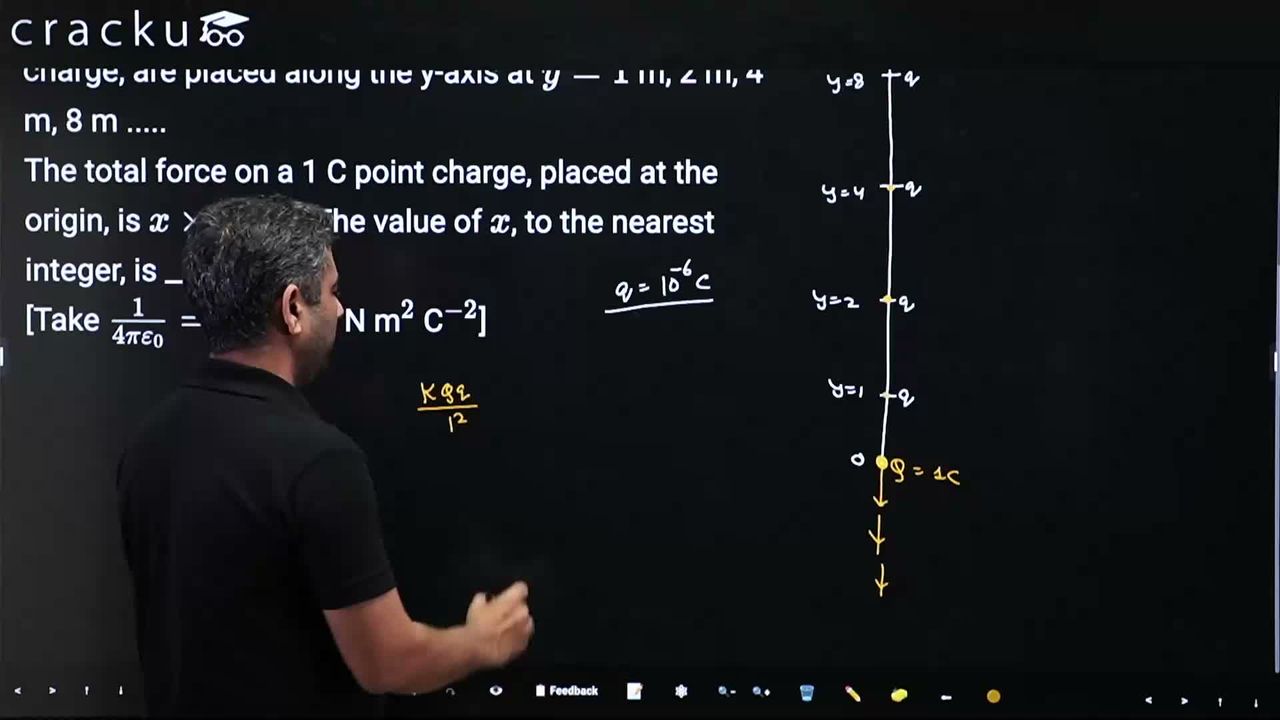
An infinite number of point charges, each carrying $$1 \mu C$$ charge, are placed along the y-axis at $$y = 1$$ m, 2 m, 4 m, 8 m .....
The total force on a 1 C point charge, placed at the origin, is $$x \times 10^3$$ N. The value of $$x$$, to the nearest integer, is ___.
[Take $$\frac{1}{4\pi\varepsilon_0} = 9 \times 10^9$$ N m$$^2$$ C$$^{-2}$$]
Correct Answer: 12
The point charges of $$1\,\mu C$$ each are placed at $$y = 1, 2, 4, 8, \ldots$$ m along the y-axis. A charge of $$1$$ C is placed at the origin. The total force on the 1 C charge is the sum of the forces due to each point charge, all directed along the y-axis.
The force due to the charge at distance $$r_n$$ is $$F_n = \frac{kQq}{r_n^2}$$. Here $$r_n = 2^{n-1}$$ m for $$n = 1, 2, 3, \ldots$$, so $$r_n^2 = 4^{n-1}$$.
The total force is $$F = kQq \sum_{n=1}^{\infty}\frac{1}{4^{n-1}} = kQq \cdot \frac{1}{1 - 1/4} = \frac{4}{3}kQq$$.
Substituting $$k = 9 \times 10^9$$, $$Q = 1$$ C, and $$q = 1 \times 10^{-6}$$ C: $$F = \frac{4}{3} \times 9 \times 10^9 \times 1 \times 10^{-6} = \frac{4}{3} \times 9 \times 10^3 = 12 \times 10^3$$ N.
Since $$F = x \times 10^3$$ N, the value of $$x$$ is $$12$$.
Was this solution helpful?
Click on the Email ☝️ to Watch the Video Solution
Create a FREE account and get:
_1.webp)

Educational materials for JEE preparation

Ask our AI anything

AI can make mistakes. Please verify important information.
AI can make mistakes. Please verify important information.
