
Join Our JEE Preparation Group
Prep with like-minded aspirants; Get access to free daily tests and study material.
Sign in
Please select an account to continue using cracku.in
↓ →
Join Our JEE Preparation Group
Prep with like-minded aspirants; Get access to free daily tests and study material.
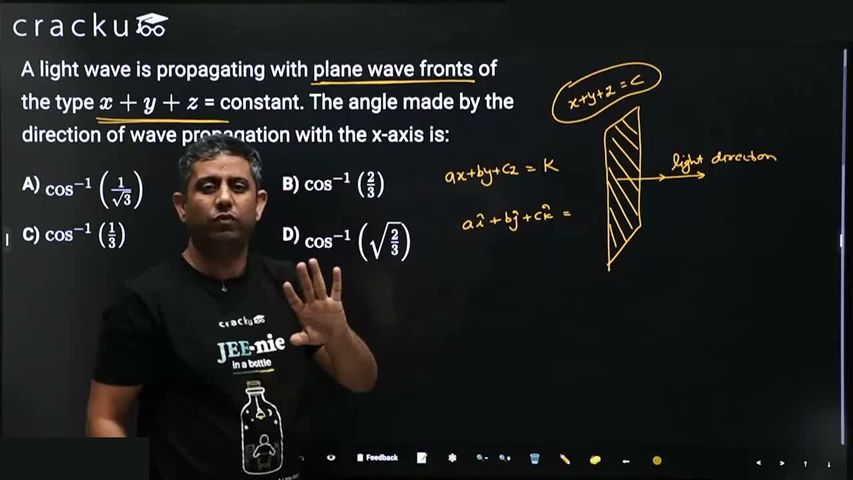
A light wave is propagating with plane wave fronts of the type $$x + y + z$$ = constant. The angle made by the direction of wave propagation with the x-axis is:
For any plane wave front, the light travels in the direction perpendicular (normal) to that plane.
A general plane can be written as $$ax + by + cz = \text{constant}$$, whose normal vector is $$\mathbf{n} = a\,\hat i + b\,\hat j + c\,\hat k$$.
The given wave fronts are $$x + y + z = \text{constant}$$.
Comparing with $$ax + by + cz = \text{constant}$$, we get the normal (and hence the direction of wave propagation)
$$\mathbf{n} = 1\,\hat i + 1\,\hat j + 1\,\hat k = \langle 1,\,1,\,1\rangle$$.
Let $$\theta$$ be the angle between the direction of propagation and the x-axis.
The x-axis is represented by the unit vector $$\hat i = \langle 1,\,0,\,0\rangle$$.
First, write the unit vector along the direction of propagation:
$$\hat u = \frac{\mathbf{n}}{|\mathbf{n}|} = \frac{\langle 1,1,1\rangle}{\sqrt{1^2 + 1^2 + 1^2}} = \frac{\langle 1,1,1\rangle}{\sqrt{3}} = \left\langle \frac{1}{\sqrt{3}},\,\frac{1}{\sqrt{3}},\,\frac{1}{\sqrt{3}}\right\rangle$$.
Using the dot-product formula $$\hat u \cdot \hat i = |\hat u|\,|\hat i| \cos\theta$$.
Since $$|\hat u| = |\hat i| = 1$$, we get
$$\cos\theta = \hat u \cdot \hat i = \left\langle \frac{1}{\sqrt{3}},\,\frac{1}{\sqrt{3}},\,\frac{1}{\sqrt{3}}\right\rangle \cdot \langle 1,0,0\rangle = \frac{1}{\sqrt{3}}$$.
Therefore, $$\theta = \cos^{-1}\left(\frac{1}{\sqrt{3}}\right).$$
The correct choice is Option A.
Was this solution helpful?
Click on the Email ☝️ to Watch the Video Solution
Create a FREE account and get:
_1.webp)

Educational materials for JEE preparation

Ask our AI anything

AI can make mistakes. Please verify important information.
AI can make mistakes. Please verify important information.


