
Join Our JEE Preparation Group
Prep with like-minded aspirants; Get access to free daily tests and study material.
Sign in
Please select an account to continue using cracku.in
↓ →
Join Our JEE Preparation Group
Prep with like-minded aspirants; Get access to free daily tests and study material.
The distance between charges $$+q$$ and $$-q$$ is $$2l$$ and between $$+2q$$ and $$-2q$$ is $$4l$$. The electrostatic potential at point $$P$$ at a distance $$r$$ from centre $$O$$ is $$-\alpha\frac{ql}{r^2} \times 10^9$$ V, where the value of $$\alpha$$ is. (Use $$\frac{1}{4\pi\varepsilon_0} = 9 \times 10^9$$ N m$$^2$$ C$$^{-2}$$)
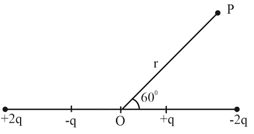
Correct Answer: 27
step 1: positions of charges
On the x-axis:
• +2q at −2l
• −q at −l
• +q at +l
• −2q at +2l
step 2: net charge
$$2q-q+q-2q=0$$
So monopole term = 0
step 3: dipole moment
Take dipole moment about O:
$$p=\sum_{ }^{ }q_ix_i$$
$$=(2q)(-2l)+(-q)(-l)+(q)(l)+(-2q)(2l)$$
$$=-4ql+ql+ql-4ql=-6ql$$So,
$$p=-6ql$$
(direction along negative x-axis)
step 4: potential at point P
For dipole:
$$V=\frac{1}{4\pi\epsilon_0}\frac{p\cos\theta}{r^2}$$
Here $$\theta=60^{\circ}$$
$$\cos60^{\circ}=\frac{1}{2}$$
$$V=9\times10^9\cdot\frac{-6ql\cdot(1/2)}{r^2}$$
$$=9\times10^9\cdot\frac{-3ql}{r^2}$$
Was this solution helpful?
Create a FREE account and get:
_1.webp)

Educational materials for JEE preparation

Ask our AI anything

AI can make mistakes. Please verify important information.
AI can make mistakes. Please verify important information.
