
Join Our JEE Preparation Group
Prep with like-minded aspirants; Get access to free daily tests and study material.
Sign in
Please select an account to continue using cracku.in
↓ →
Join Our JEE Preparation Group
Prep with like-minded aspirants; Get access to free daily tests and study material.
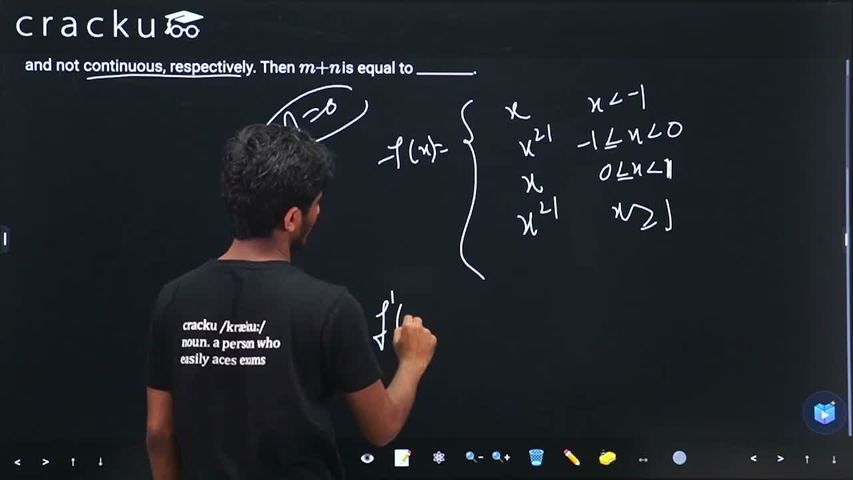
Let m and n be the number of points at which the function $$f(x) = \max\{x, x^3, x^5, \ldots, x^{21}\}$$, $$x \in \mathbb{R}$$, is not differentiable and not continuous, respectively. Then $$m + n$$ is equal to ________.
Correct Answer: 3
The function is the maximum of all odd powers of $$x$$ up to $$x^{21}$$:
$$f(x)=\max\{x,\;x^{3},\;x^{5},\ldots ,x^{21}\},\qquad x\in\mathbb{R}$$
Because all exponents are odd, the sign of every term equals the sign of $$x$$. To decide which power is largest in each interval, compare their magnitudes.
Case 1: $$x\gt 1$$.
For numbers bigger than $$1$$, the higher the exponent, the larger the value.
Hence the $$21^{\text{st}}$$ power dominates:
$$f(x)=x^{21},\qquad x\in(1,\infty)$$
Case 2: $$0\lt x\lt 1$$.
For numbers between $$0$$ and $$1$$, higher exponents make the value smaller.
Thus the first power is the greatest:
$$f(x)=x,\qquad x\in(0,1)$$
Case 3: $$-1\lt x\lt 0$$.
Here the values are negative but their absolute values are less than $$1$$.
The term closest to zero (largest among negatives) is again the highest exponent:
$$f(x)=x^{21},\qquad x\in(-1,0)$$
Case 4: $$x\lt -1$$.
For negative numbers with magnitude exceeding $$1$$, higher powers are more negative.
The least negative term is the first power:
$$f(x)=x,\qquad x\in(-\infty,-1)$$
The only points where the defining formula changes are $$x=-1,\,0,\,1$$. These are the only candidates for non-continuity or non-differentiability.
Continuity check
Compute the two candidate expressions at the switching points.
At $$x=-1$$: $$x=-1,\;x^{21}=(-1)^{21}=-1\;\Rightarrow\;f(-1)=-1$$.
Both one-sided limits equal $$-1$$, so $$f$$ is continuous.
At $$x=0$$: all terms are $$0\;\Rightarrow\;f(0)=0$$. Both one-sided limits are $$0$$, so $$f$$ is continuous.
At $$x=1$$: $$x=1,\;x^{21}=1\;\Rightarrow\;f(1)=1$$. Both one-sided limits are $$1$$, so $$f$$ is continuous.
Therefore the function is continuous everywhere, giving
$$n=0$$
Differentiability check
On each open interval the function equals an elementary power and is differentiable. Check derivatives from the left and right at the three boundary points.
The two relevant derivatives are
Left region (where $$f(x)=x$$): $$f'(x)=1$$.
Right region (where $$f(x)=x^{21}$$): $$f'(x)=21x^{20}$$.
• At $$x=-1$$: left derivative $$1$$, right derivative $$21(-1)^{20}=21$$ ⟹ unequal.
• At $$x=0$$: left derivative $$21(0)^{20}=0$$, right derivative $$1$$ ⟹ unequal.
• At $$x=1$$: left derivative $$1$$, right derivative $$21(1)^{20}=21$$ ⟹ unequal.
Hence $$f(x)$$ is not differentiable at exactly three points: $$x=-1,\,0,\,1$$.
Thus
$$m=3$$
Finally, $$m+n=3+0=3$$.
Answer: 3
Was this solution helpful?
Click on the Email ☝️ to Watch the Video Solution
Create a FREE account and get:
_1.webp)

Educational materials for JEE preparation

Ask our AI anything

AI can make mistakes. Please verify important information.
AI can make mistakes. Please verify important information.
