
Join Our JEE Preparation Group
Prep with like-minded aspirants; Get access to free daily tests and study material.
Sign in
Please select an account to continue using cracku.in
↓ →
Join Our JEE Preparation Group
Prep with like-minded aspirants; Get access to free daily tests and study material.
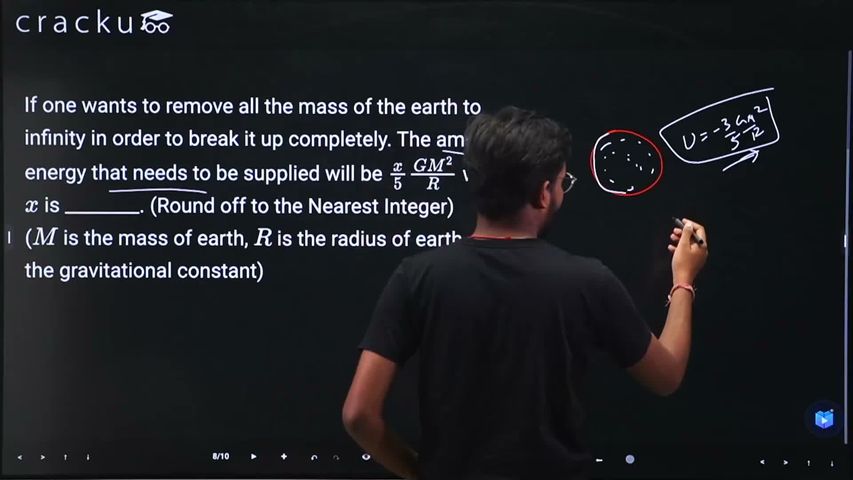
If one wants to remove all the mass of the earth to infinity in order to break it up completely. The amount of energy that needs to be supplied will be $$\frac{x}{5}\frac{GM^2}{R}$$ where $$x$$ is ________. (Round off to the Nearest Integer)
($$M$$ is the mass of earth, $$R$$ is the radius of earth, $$G$$ is the gravitational constant)
Correct Answer: 3
We need to find the value of $$x$$ to the nearest integer, which represents the numerical coefficient in the expression for the energy required to completely break up the Earth by removing all of its mass to infinity.
Breaking up a solid celestial body completely means separating all of its constituent particles by an infinite distance. The energy required to accomplish this is equal to the magnitude of the gravitational self-energy (or binding energy) of the body.
Assuming the Earth is a perfectly uniform solid sphere of mass $$M$$ and radius $$R$$, its gravitational binding energy ($$U$$) can be derived by integrating the work required to assemble the sphere layer by layer from infinity:
$$U = -\frac{3}{5}\frac{GM^2}{R}$$
The negative sign indicates that the system is bound together by attractive gravitational forces.
To break up the Earth completely and remove all its mass to infinity, we must supply an external energy ($$E$$) equal to the absolute value of this binding energy to bring the total energy of the system up to zero:
$$E = |U| = \frac{3}{5}\frac{GM^2}{R}$$
The problem states that the amount of energy that needs to be supplied is given by the expression:
$$E = \frac{x}{5}\frac{GM^2}{R}$$
By comparing our derived formula with the given expression:
$$\frac{3}{5}\frac{GM^2}{R} = \frac{x}{5}\frac{GM^2}{R}$$
This directly simplifies to yield $$x = 3$$.
Therefore, the value of $$x$$ rounded to the nearest integer is 3.
Click on the Email ☝️ to Watch the Video Solution
Create a FREE account and get:
_1.webp)

Educational materials for JEE preparation

Ask our AI anything

AI can make mistakes. Please verify important information.
AI can make mistakes. Please verify important information.


