
Join Our JEE Preparation Group
Prep with like-minded aspirants; Get access to free daily tests and study material.
Sign in
Please select an account to continue using cracku.in
↓ →
Join Our JEE Preparation Group
Prep with like-minded aspirants; Get access to free daily tests and study material.
If $$K=\tan\left(\frac{\pi}{4}+\frac{1}{2}\cos^{-1}\left(\frac{2}{3}\right)\right)+\tan\left(\frac{1}{2}\sin^{-1}\left(\frac{2}{3}\right)\right)$$, then the number of solutions of the equation $$\sin^{-1}(kx-1)=\sin^{-1} x-\cos^{-1} x$$ is______.
Correct Answer: 1
Let $$\alpha=\cos^{-1}\!\left(\frac23\right)$$ so that $$\cos\alpha=\frac23$$ and $$\sin\alpha=\sqrt{1-\frac49}=\frac{\sqrt5}{3}$$.
Using the half-angle identity $$\tan\frac\alpha2=\frac{\sin\alpha}{1+\cos\alpha}$$,
$$\tan\frac\alpha2=\frac{\frac{\sqrt5}{3}}{1+\frac23}=\frac{\sqrt5}{5}$$.
Now apply $$\tan(A+B)=\dfrac{\tan A+\tan B}{1-\tan A\tan B}$$ with $$A=\frac\pi4,\;B=\frac\alpha2$$:
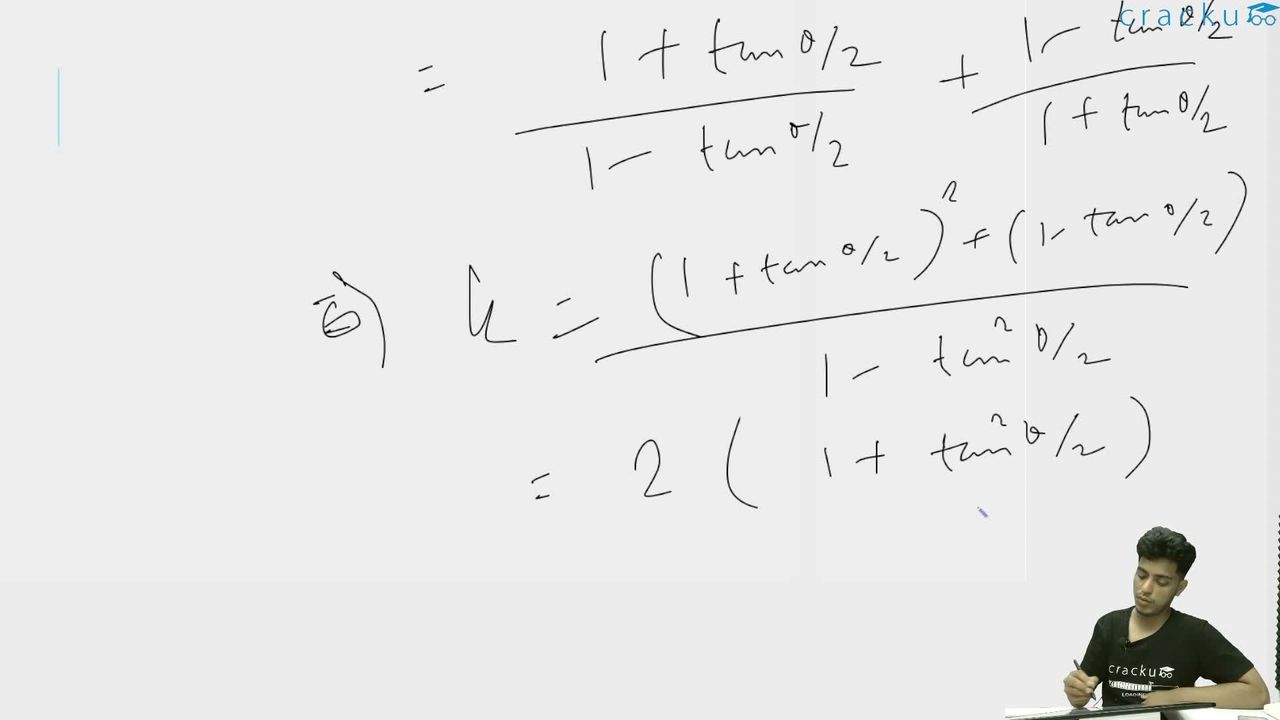
$$\tan\!\left(\frac\pi4+\frac\alpha2\right)=\frac{1+\frac{\sqrt5}{5}}{1-\frac{\sqrt5}{5}}
=\frac{5+\sqrt5}{5-\sqrt5}
=\frac{(5+\sqrt5)^2}{20}
=\frac{30+10\sqrt5}{20}
=\frac{3+\sqrt5}{2}.$$
Next, let $$\beta=\sin^{-1}\!\left(\frac23\right)$$. Then $$\sin\beta=\frac23,\;\cos\beta=\frac{\sqrt5}{3}$$ and again
$$\tan\frac\beta2=\frac{\sin\beta}{1+\cos\beta}
=\frac{\frac23}{1+\frac{\sqrt5}{3}}
=\frac{2}{3+\sqrt5}
=\frac{3-\sqrt5}{2}.$$
Hence
$$K=\tan\!\left(\frac\pi4+\frac{\alpha}{2}\right)+\tan\!\left(\frac{\beta}{2}\right)
=\frac{3+\sqrt5}{2}+\frac{3-\sqrt5}{2}=3.$$
The given equation becomes
$$\sin^{-1}(3x-1)=\sin^{-1}x-\cos^{-1}x.$$
Since $$\sin^{-1}x+\cos^{-1}x=\frac\pi2,$$ rewrite the right side:
$$\sin^{-1}(3x-1)=2\sin^{-1}x-\frac\pi2.$$ $$-(1)$$
Domain restrictions:
1. $$x\in[-1,1]$$ (from $$\sin^{-1}x$$).
2. $$-1\le 3x-1\le 1\;\Longrightarrow\;0\le x\le\frac23.$$
Therefore $$x\in[0,\frac23].$$
Set $$t=\sin^{-1}x\;(0\le t\le\frac\pi2).$$
Equation $$(1)$$ becomes $$\sin^{-1}(3\sin t-1)=2t-\frac\pi2.$$
Taking sine on both sides (which is safe because both sides now lie in $$[-\frac\pi2,\frac\pi2]$$):
$$3\sin t-1=\sin\!\left(2t-\frac\pi2\right).$$
Use $$\sin(A-\frac\pi2)=-\cos A$$ to get
$$3\sin t-1=-\cos(2t).$$
With $$\cos(2t)=1-2\sin^2 t=1-2x^2$$, substitute back $$x=\sin t$$:
$$3x-1=-(1-2x^2)=-1+2x^2.$$
Hence
$$3x-1=-1+2x^2\;\Longrightarrow\;2x^2-3x=0
\;\Longrightarrow\;x(2x-3)=0.$$
Possible roots: $$x=0,\;x=\frac32.$$
Only $$x=0$$ lies in the allowed interval $$[0,\frac23]$$, and it satisfies the original equation because
left side = $$\sin^{-1}(-1)=-\frac\pi2,$$
right side = $$\sin^{-1}(0)-\cos^{-1}(0)=0-\frac\pi2=-\frac\pi2.$$
Therefore exactly one solution exists.
Number of solutions = 1.
Was this solution helpful?
Click on the Email ☝️ to Watch the Video Solution
Create a FREE account and get:
_1.webp)

Educational materials for JEE preparation

Ask our AI anything

AI can make mistakes. Please verify important information.
AI can make mistakes. Please verify important information.
