
Join Our JEE Preparation Group
Prep with like-minded aspirants; Get access to free daily tests and study material.
Sign in
Please select an account to continue using cracku.in
↓ →
Join Our JEE Preparation Group
Prep with like-minded aspirants; Get access to free daily tests and study material.
Three distinct numbers are selected randomly from the set $$\{1, 2, 3, \ldots, 40\}$$. If the probability, that the selected numbers are in an increasing G.P. is $$\frac{m}{n}$$, $$\gcd(m, n) = 1$$, then $$m + n$$ is equal to _____.
Correct Answer: 2477
We are selecting 3 distinct numbers randomly from the set $$ \{1, 2, 3, \ldots, 40\} $$.
Step 1: Calculate the Total Number of Outcomes
The total number of ways to select 3 distinct numbers from a set of 40 numbers is given by the combination formula:
$$ \text{Total Ways} = \binom{40}{3} = \frac{40 \times 39 \times 38}{3 \times 2 \times 1} = 9880 $$
Step 2: Find the Favorable Outcomes (Increasing G.P.)
Let the three selected numbers be $$ a, b, c $$ such that they form an increasing geometric progression ($$ a < b < c $$).
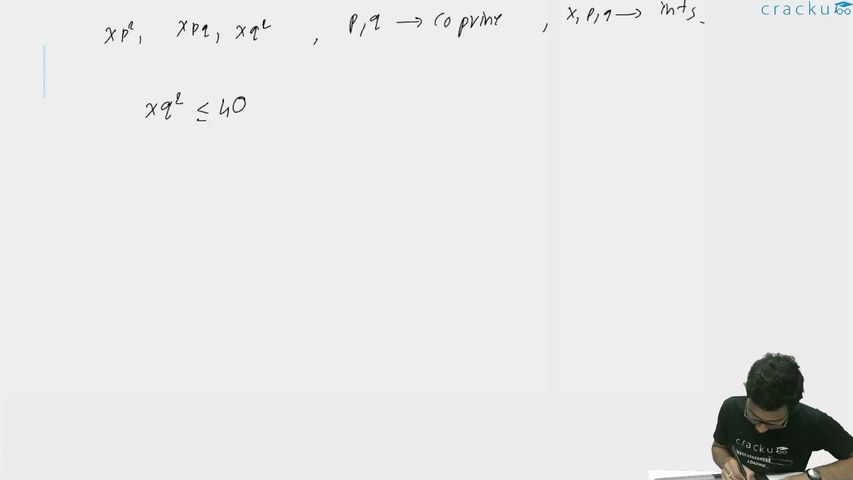
Any three integers forming a geometric progression can be written in the form:
$$ a = x \cdot p^2 $$
$$ b = x \cdot p \cdot q $$
$$ c = x \cdot q^2 $$
where $$ x, p, q $$ are positive integers such that $$ \gcd(p, q) = 1 $$ and $$ q > p \ge 1 $$.
Since the numbers belong to the set, the maximum number $$ c $$ must satisfy:
$$ c = x \cdot q^2 \le 40 $$
We can find the number of valid combinations by iterating through the possible values of $$ q $$ (where $$ q^2 \le 40 $$):
1. For $$ q = 2 $$:
The only coprime value for $$ p $$ is 1.
$$ x \cdot 2^2 \le 40 \implies 4x \le 40 \implies x \in \{1, 2, \ldots, 10\} $$ (10 ways)
2. For $$ q = 3 $$:
The coprime values for $$ p $$ are 1 and 2.
$$ x \cdot 3^2 \le 40 \implies 9x \le 40 \implies x \in \{1, 2, 3, 4\} $$ (4 ways per $$ p $$, so $$ 2 \times 4 = 8 $$ ways)
3. For $$ q = 4 $$:
The coprime values for $$ p $$ are 1 and 3 (since $$ \gcd(2,4) \neq 1 $$).
$$ x \cdot 4^2 \le 40 \implies 16x \le 40 \implies x \in \{1, 2\} $$ (2 ways per $$ p $$, so $$ 2 \times 2 = 4 $$ ways)
4. For $$ q = 5 $$:
The coprime values for $$ p $$ are 1, 2, 3, and 4.
$$ x \cdot 5^2 \le 40 \implies 25x \le 40 \implies x \in \{1\} $$ (1 way per $$ p $$, so $$ 4 \times 1 = 4 $$ ways)
5. For $$ q = 6 $$:
The coprime values for $$ p $$ are 1 and 5.
$$ x \cdot 6^2 \le 40 \implies 36x \le 40 \implies x \in \{1\} $$ (1 way per $$ p $$, so $$ 2 \times 1 = 2 $$ ways)
Summing all the favorable ways together:
$$ \text{Favorable Ways} = 10 + 8 + 4 + 4 + 2 = 28 $$
Step 3: Compute the Probability $$ \frac{m}{n} $$
The probability of selecting numbers that form an increasing G.P. is:
$$ \text{Probability} = \frac{\text{Favorable Ways}}{\text{Total Ways}} = \frac{28}{9880} $$
Simplifying this fraction by dividing the numerator and denominator by their greatest common divisor, which is 4:
$$ \frac{m}{n} = \frac{7}{2470} $$
Since 7 is a prime number and does not divide 2470, the fraction is in its lowest terms ($$ \gcd(m, n) = 1 $$).
Thus, we have:
$$ m = 7 $$
$$ n = 2470 $$
Step 4: Calculate $$ m + n $$
$$ m + n = 7 + 2470 = 2477 $$
Therefore, the final value of $$ m + n $$ is 2477.
Was this solution helpful?
Click on the Email ☝️ to Watch the Video Solution
Create a FREE account and get:
_1.webp)

Educational materials for JEE preparation

Ask our AI anything

AI can make mistakes. Please verify important information.
AI can make mistakes. Please verify important information.


