
Join Our JEE Preparation Group
Prep with like-minded aspirants; Get access to free daily tests and study material.
Sign in
Please select an account to continue using cracku.in
↓ →
Join Our JEE Preparation Group
Prep with like-minded aspirants; Get access to free daily tests and study material.
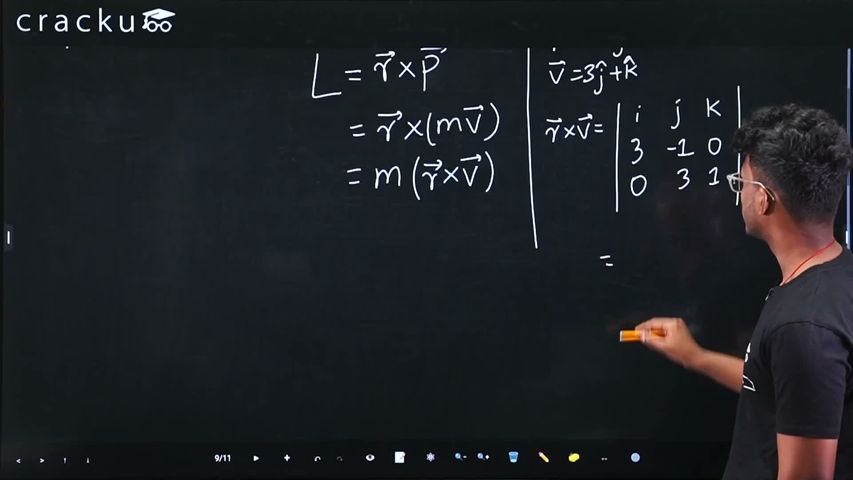
The position vector of $$1$$ kg object is $$\vec{r} = (3\hat{i} - \hat{j})$$ m and its velocity $$\vec{v} = (3\hat{j} + \hat{k})$$ m s$$^{-1}$$. The magnitude of its angular momentum is $$\sqrt{x}$$ N m s, where $$x$$ is ______
Correct Answer: 91
We need to find the magnitude of the angular momentum of a 1 kg object. The mass is $$m = 1$$ kg, the position vector is $$\vec{r} = 3\hat{i} - \hat{j}$$ m, and the velocity is $$\vec{v} = 3\hat{j} + \hat{k}$$ m/s.
Since linear momentum is $$\vec{p} = m\vec{v} = 1 \times (3\hat{j} + \hat{k}) = 3\hat{j} + \hat{k}$$, substituting into the definition of angular momentum $$\vec{L} = \vec{r} \times \vec{p}$$ gives
$$\vec{L} = \vec{r} \times \vec{p} = (3\hat{i} - \hat{j}) \times (3\hat{j} + \hat{k})$$
Using the determinant method,
$$\vec{L} = \begin{vmatrix} \hat{i} & \hat{j} & \hat{k} \\ 3 & -1 & 0 \\ 0 & 3 & 1 \end{vmatrix}$$
Expanding the determinant yields
$$\vec{L} = \hat{i}[(-1)(1) - (0)(3)] - \hat{j}[(3)(1) - (0)(0)] + \hat{k}[(3)(3) - (-1)(0)]$$
$$\vec{L} = \hat{i}[-1 - 0] - \hat{j}[3 - 0] + \hat{k}[9 - 0]$$
$$\vec{L} = -\hat{i} - 3\hat{j} + 9\hat{k}$$
The magnitude is
$$|\vec{L}| = \sqrt{(-1)^2 + (-3)^2 + (9)^2}$$
$$|\vec{L}| = \sqrt{1 + 9 + 81}$$
$$|\vec{L}| = \sqrt{91} \text{ N m s}$$
Comparing with $$\sqrt{x}$$, we get $$x = 91$$, so the answer is 91.
Was this solution helpful?
Click on the Email ☝️ to Watch the Video Solution
Create a FREE account and get:
_1.webp)

Educational materials for JEE preparation

Ask our AI anything

AI can make mistakes. Please verify important information.
AI can make mistakes. Please verify important information.
