
Join Our JEE Preparation Group
Prep with like-minded aspirants; Get access to free daily tests and study material.
Sign in
Please select an account to continue using cracku.in
↓ →
Join Our JEE Preparation Group
Prep with like-minded aspirants; Get access to free daily tests and study material.
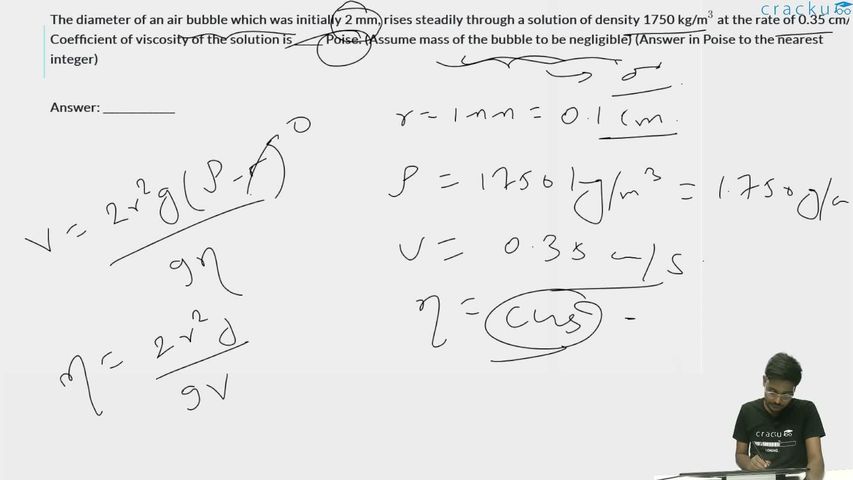
The diameter of an air bubble which was initially 2 mm, rises steadily through a solution of density 1750 kg/m$$^3$$ at the rate of 0.35 cm/s. Coefficient of viscosity of the solution is _____ Poise. (Assume mass of the bubble to be negligible) (Answer in Poise to the nearest integer)
Correct Answer: 11
We use Stokes' law for terminal velocity of a sphere rising through a viscous medium. For an air bubble rising in a liquid, the buoyant force drives the motion and viscous drag opposes it.
Given data:
Diameter of bubble = 2 mm, so radius $$r = 1$$ mm = $$0.1$$ cm
Density of solution $$\rho = 1750$$ kg/m$$^3$$ = 1.75 g/cm$$^3$$
Terminal velocity $$v = 0.35$$ cm/s
Mass of the bubble is negligible, so density of bubble $$\sigma \approx 0$$
Using Stokes' law for terminal velocity:
$$v = \frac{2r^2(\rho - \sigma)g}{9\eta}$$
Since $$\sigma \approx 0$$:
$$v = \frac{2r^2 \rho g}{9\eta}$$
Solving for viscosity $$\eta$$:
$$\eta = \frac{2r^2 \rho g}{9v}$$
Substituting the values in CGS units ($$g = 980$$ cm/s$$^2$$):
$$\eta = \frac{2 \times (0.1)^2 \times 1.75 \times 980}{9 \times 0.35}$$
$$\eta = \frac{2 \times 0.01 \times 1.75 \times 980}{3.15}$$
$$\eta = \frac{34.3}{3.15}$$
$$\eta \approx 10.89 \text{ Poise}$$
Rounding to the nearest integer:
$$\eta \approx 11 \text{ Poise}$$
Therefore, the coefficient of viscosity is 11 Poise.
Was this solution helpful?
Click on the Email ☝️ to Watch the Video Solution
Create a FREE account and get:
_1.webp)

Educational materials for JEE preparation

Ask our AI anything

AI can make mistakes. Please verify important information.
AI can make mistakes. Please verify important information.
