
Join Our JEE Preparation Group
Prep with like-minded aspirants; Get access to free daily tests and study material.
Sign in
Please select an account to continue using cracku.in
↓ →
Join Our JEE Preparation Group
Prep with like-minded aspirants; Get access to free daily tests and study material.
Let $$f:R\rightarrow R$$ be a twice differentiable function such that the quadratic equation $$f(x)m^{2}-2 f'(x)m+ f''(x)=0$$ in m, has two equal roots for every $$x \epsilon R$$. If $$ f(0)=1,f'(0)=2$$, and $$(\alpha,\beta)$$ is the largest interval in which the function $$f(\log_{e}{x-x})$$ is increasing, then $$\alpha+\beta$$ is equal to ________.
Correct Answer: 1
The quadratic $$f(x)m^2 - 2f'(x)m + f''(x) = 0$$ has two equal roots for every x.
Discriminant = 0: $$4(f'(x))^2 - 4f(x)f''(x) = 0 \Rightarrow (f')^2 = f \cdot f''$$.
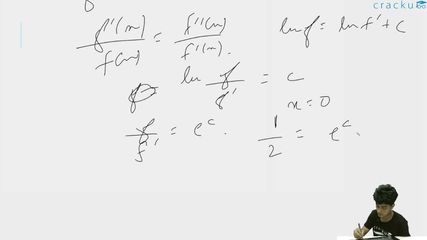
This means $$\frac{f''}{f'} = \frac{f'}{f}$$, i.e., $$(\ln f')' = (\ln f)'$$, so $$\ln f' = \ln f + C$$.
$$f' = Af$$ where $$A = e^C$$. Solution: $$f(x) = Be^{Ax}$$.
$$f(0) = 1 \Rightarrow B = 1$$. $$f'(0) = A = 2$$.
So $$f(x) = e^{2x}$$.
$$g(x) = f(\ln x - x) = e^{2(\ln x - x)} = x^2 e^{-2x}$$.
$$g'(x) = 2xe^{-2x} - 2x^2e^{-2x} = 2xe^{-2x}(1-x) > 0$$ when $$0 < x < 1$$.
$$g$$ is increasing on $$(0, 1)$$. But we also need $$\ln x - x$$ to be in the domain (it's all reals for $$f = e^{2x}$$). The domain of $$g$$ is $$x > 0$$ (since $$\ln x$$ requires $$x > 0$$).
So $$(\alpha, \beta) = (0, 1)$$. $$\alpha + \beta = 0 + 1 = 1$$.
The answer is 1.
Was this solution helpful?
Click on the Email ☝️ to Watch the Video Solution
Create a FREE account and get:
_1.webp)

Educational materials for JEE preparation

Ask our AI anything

AI can make mistakes. Please verify important information.
AI can make mistakes. Please verify important information.
