
Join Our JEE Preparation Group
Prep with like-minded aspirants; Get access to free daily tests and study material.
Sign in
Please select an account to continue using cracku.in
↓ →
Join Our JEE Preparation Group
Prep with like-minded aspirants; Get access to free daily tests and study material.
If the number of seven-digit numbers, such that the sum of their digits is even, is $$m \cdot n \cdot 10^n$$; $$m, n \in \{1, 2, 3, \ldots, 9\}$$, then $$m + n$$ is equal to __________.
Correct Answer: 14
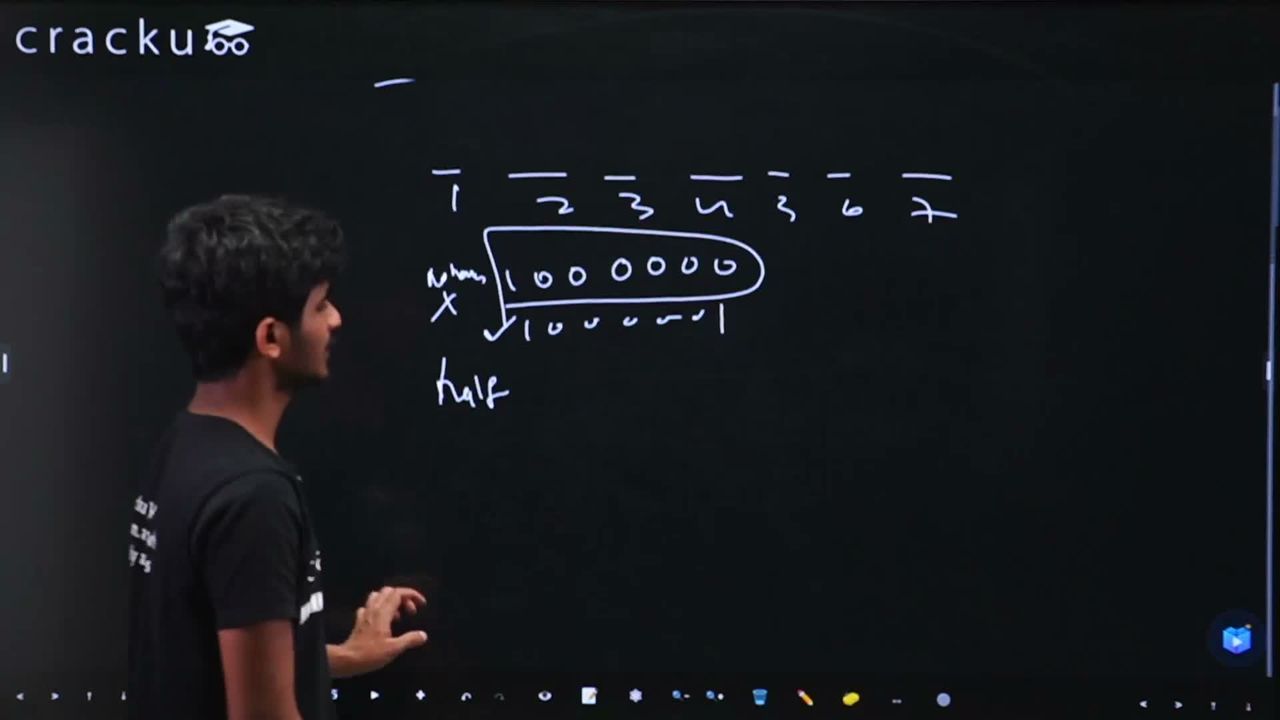
Let $$S$$ be the set of all seven-digit natural numbers. A seven-digit number has its first (left-most) digit from $$1$$ to $$9$$ and each of the remaining six digits from $$0$$ to $$9$$, so
total elements in $$S = 9 \times 10^{6} = 90\,00\,00\,00 = 9{,}000{,}000$$
We must count those numbers in $$S$$ whose digit-sum is even. Denote this subset by $$E$$ and let $$O$$ be the subset with odd digit-sum.
Key idea (Parity-changing bijection): For every number in $$S$$ we will construct a unique partner in $$S$$ whose digit-sum parity is opposite.
Take a number with decimal representation $$a_1a_2a_3a_4a_5a_6a_7$$.
Define a mapping $$f:S \rightarrow S$$ by changing only the last digit:
• if $$a_7$$ is even, replace it by $$a_7+1$$ (this is odd);
• if $$a_7$$ is odd, replace it by $$a_7-1$$ (this is even).
This mapping leaves the first digit $$a_1$$ unchanged (so the image is still seven-digit) and clearly toggles the parity of the digit-sum. Moreover, the rule is reversible—applying it twice returns the original number—so $$f$$ is a bijection between $$E$$ and $$O$$.
Therefore $$|E| = |O| = \dfrac{|S|}{2} = \dfrac{9\,000\,000}{2} = 4\,500\,000$$.
Write the answer in the required form $$m \cdot n \cdot 10^{\,n}$$ with $$m,n \in \{1,2,\ldots ,9\}$$.
Observe $$4\,500\,000 = 45 \times 10^{5}$$.
Factor the coefficient $$45$$ as the product of two single-digit numbers: $$45 = 9 \times 5$$.
Thus $$m = 9,\; n = 5$$ and the requested sum is
$$m + n = 9 + 5 = 14.$$
Final answer: $$14$$.
Was this solution helpful?
Click on the Email ☝️ to Watch the Video Solution
Create a FREE account and get:
_1.webp)

Educational materials for JEE preparation

Ask our AI anything

AI can make mistakes. Please verify important information.
AI can make mistakes. Please verify important information.


