
Join Our JEE Preparation Group
Prep with like-minded aspirants; Get access to free daily tests and study material.
Sign in
Please select an account to continue using cracku.in
↓ →
Join Our JEE Preparation Group
Prep with like-minded aspirants; Get access to free daily tests and study material.
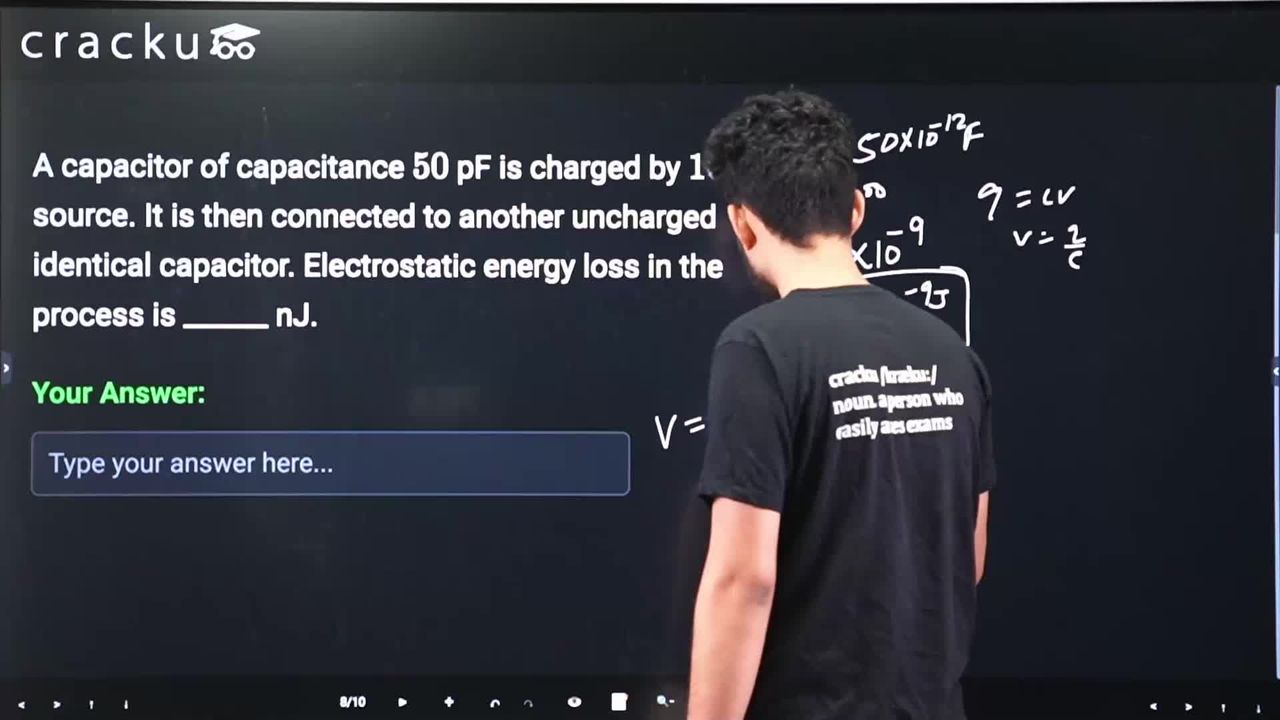
A capacitor of capacitance $$50$$ pF is charged by $$100$$ V source. It is then connected to another uncharged identical capacitor. Electrostatic energy loss in the process is ______ nJ.
Correct Answer: 125
A capacitor of 50 pF is charged by a 100 V source, then connected to another uncharged identical capacitor.
The initial energy stored in the capacitor is $$U_i = \frac{1}{2}CV^2 = \frac{1}{2} \times 50 \times 10^{-12} \times (100)^2$$. Substituting the values gives $$U_i = \frac{1}{2} \times 50 \times 10^{-12} \times 10000 = 250 \times 10^{-9} \text{ J} = 250 \text{ nJ}$$.
When this capacitor is connected to an identical uncharged one, the total charge is shared equally and the final voltage across each capacitor is $$V_f = \frac{Q_{total}}{C_{total}} = \frac{CV}{2C} = \frac{V}{2} = 50 \text{ V}$$.
The total energy stored in the two capacitors after connection is $$U_f = \frac{1}{2}(2C)V_f^2 = \frac{1}{2} \times 2 \times 50 \times 10^{-12} \times (50)^2$$, which gives $$U_f = 50 \times 10^{-12} \times 2500 = 125 \times 10^{-9} \text{ J} = 125 \text{ nJ}$$.
The energy loss is the difference between the initial and final energies: $$\Delta U = U_i - U_f = 250 - 125 = 125 \text{ nJ}$$.
The electrostatic energy loss is 125 nJ.
Was this solution helpful?
Click on the Email ☝️ to Watch the Video Solution
Create a FREE account and get:
_1.webp)

Educational materials for JEE preparation

Ask our AI anything

AI can make mistakes. Please verify important information.
AI can make mistakes. Please verify important information.
