
Join Our JEE Preparation Group
Prep with like-minded aspirants; Get access to free daily tests and study material.
Sign in
Please select an account to continue using cracku.in
↓ →
Join Our JEE Preparation Group
Prep with like-minded aspirants; Get access to free daily tests and study material.
Let a vector $$\vec{a} = \sqrt{2}\,\hat{i} - \hat{j} + \lambda \hat{k}, \quad \lambda > 0,$$ make an obtuse angle with the vector $$\vec{b} = -\lambda^{2}\hat{i} + 4\sqrt{2}\,\hat{j} + 4\sqrt{2}\,\hat{k}$$ and an angle $$\theta, \dfrac{\pi}{6} < \theta < \dfrac{\pi}{2}$$, with the positive z-axis. If the set of all possible values of $$\lambda$$ is $$( \alpha, \beta) - \{\gamma\}$$, then $$\alpha + \beta + \gamma$$ is equal to __________.
Correct Answer: 5
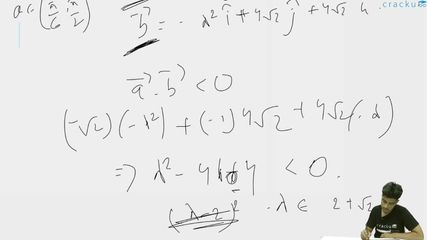
$$\vec{a}=(-\sqrt{2},-1,-\lambda),\quad\vec{b}=(-\lambda^2,,4\sqrt{2},,4\sqrt{2}),\quad\lambda>0.$$
First, for an obtuse angle:
$$\vec{a}\cdot\vec{b}<0$$
$$(-\sqrt{2})(-\lambda^2)+(-1)(4\sqrt{2})+(-\lambda)(4\sqrt{2})=\sqrt{2}\lambda^2-4\sqrt{2}-4\sqrt{2}\lambda$$
Divide by $$(\sqrt{2})$$:
$$\lambda^2-4\lambda-4<0$$
Solving:
$$2-2\sqrt{2}<\lambda<2+2\sqrt{2}$$
Since ($$\lambda>0):$$
$$0<\lambda<2+2\sqrt{2}$$
Now for the angle with the positive (z)-axis:
$$\cos\theta=\frac{\lambda}{\sqrt{3+\lambda^2}}$$
$$\frac{\pi}{6}<\theta<\frac{\pi}{2}$$
$$\Rightarrow0<\cos\theta<\frac{\sqrt{3}}{2}\frac{\pi}{6}<\theta<\frac{\pi}{2}$$
$$\frac{\lambda}{\sqrt{3+\lambda^2}}<\frac{\sqrt{3}}{2}$$
Squaring:
$$\frac{\lambda^2}{3+\lambda^2}<\frac{3}{4}$$
$$\Rightarrow\lambda^2<9$$
$$\Rightarrow\lambda<3$$
Thus:
$$0<\lambda<3$$
Excluding $$(\lambda=2),$$ we get:
(0,3) - {2}
$$\alpha=0,\ \beta=3,\ \gamma=2$$
Final answer: 5
Was this solution helpful?
Click on the Email ☝️ to Watch the Video Solution
Create a FREE account and get:
_1.webp)

Educational materials for JEE preparation

Ask our AI anything

AI can make mistakes. Please verify important information.
AI can make mistakes. Please verify important information.
