
Join Our JEE Preparation Group
Prep with like-minded aspirants; Get access to free daily tests and study material.
Sign in
Please select an account to continue using cracku.in
↓ →
Join Our JEE Preparation Group
Prep with like-minded aspirants; Get access to free daily tests and study material.
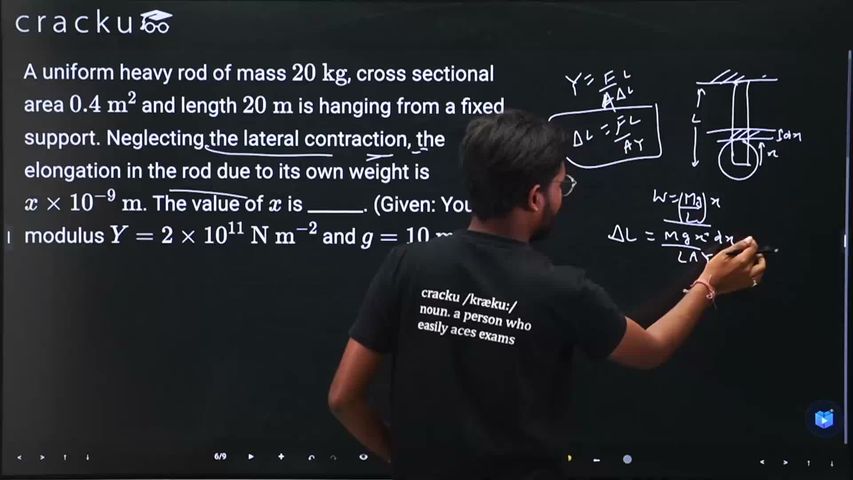
A uniform heavy rod of mass $$20 \text{ kg}$$, cross sectional area $$0.4 \text{ m}^2$$ and length $$20 \text{ m}$$ is hanging from a fixed support. Neglecting the lateral contraction, the elongation in the rod due to its own weight is $$x \times 10^{-9} \text{ m}$$. The value of $$x$$ is ______. (Given: Young's modulus $$Y = 2 \times 10^{11} \text{ N m}^{-2}$$ and $$g = 10 \text{ m s}^{-2}$$)
Correct Answer: 25
For a uniform rod hanging vertically under its own weight, the elongation due to its own weight is given by $$\Delta L = \frac{MgL}{2AY}$$ where $$M = 20 \text{ kg}$$, $$g = 10 \text{ m/s}^2$$, $$L = 20 \text{ m}$$, $$A = 0.4 \text{ m}^2$$, and $$Y = 2 \times 10^{11} \text{ N/m}^2$$.
Considering a small element at distance $$x$$ from the bottom, the weight below it is $$\frac{Mg}{L} \cdot x$$. The stress on this element is $$\frac{Mgx}{AL}$$ and the elongation of the element is $$d(\Delta L) = \frac{Mgx}{ALY} \, dx$$.
Integrating from $$0$$ to $$L$$ yields $$\Delta L = \frac{Mg}{ALY} \int_0^L x \, dx = \frac{Mg}{ALY} \cdot \frac{L^2}{2} = \frac{MgL}{2AY}$$.
Substituting the values into the formula gives $$\Delta L = \frac{20 \times 10 \times 20}{2 \times 0.4 \times 2 \times 10^{11}} = \frac{4000}{1.6 \times 10^{11}} = 25 \times 10^{-9} \text{ m}$$.
Therefore, $$x = \textbf{25}$$.
Was this solution helpful?
Click on the Email ☝️ to Watch the Video Solution
Create a FREE account and get:
_1.webp)

Educational materials for JEE preparation

Ask our AI anything

AI can make mistakes. Please verify important information.
AI can make mistakes. Please verify important information.
