
Join Our JEE Preparation Group
Prep with like-minded aspirants; Get access to free daily tests and study material.
Sign in
Please select an account to continue using cracku.in
↓ →
Join Our JEE Preparation Group
Prep with like-minded aspirants; Get access to free daily tests and study material.
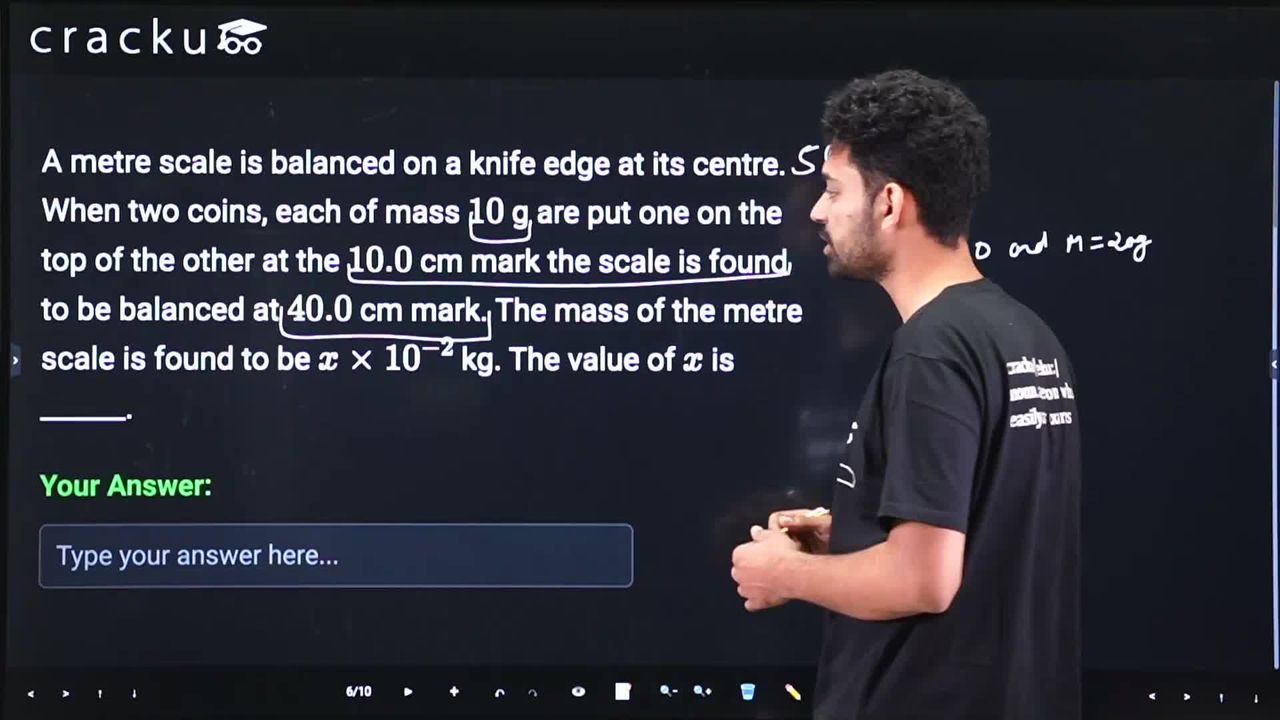
A metre scale is balanced on a knife edge at its centre. When two coins, each of mass $$10$$ g are put one on the top of the other at the $$10.0$$ cm mark the scale is found to be balanced at $$40.0$$ cm mark. The mass of the metre scale is found to be $$x \times 10^{-2}$$ kg. The value of $$x$$ is ______.
Correct Answer: 6
A metre scale is initially balanced at its centre (the 50 cm mark). Two coins, each of mass 10 g (total mass = 20 g), are placed at the 10.0 cm mark, and the new balance point shifts to the 40.0 cm mark.
Concept: For the scale to be balanced at the new pivot (40 cm mark), the net torque about this point must be zero. The weight of the metre scale acts at its centre of gravity, which is at the 50 cm mark (since it is uniform).
Calculate the torques about the 40 cm mark: the coins (20 g) are at the 10 cm mark, which is $$40 - 10 = 30$$ cm to the left of the pivot.
The centre of gravity of the scale is at the 50 cm mark, which is $$50 - 40 = 10$$ cm to the right of the pivot.
Apply the condition for rotational equilibrium (net torque = 0):: $$\text{Anticlockwise torque} = \text{Clockwise torque}$$
$$20 \times 30 = M \times 10$$
$$600 = 10M$$
$$M = 60 \text{ g} = 60 \times 10^{-3} \text{ kg} = 6 \times 10^{-2} \text{ kg}$$
Since the mass is given as $$x \times 10^{-2}$$ kg, we get $$x = \mathbf{6}$$.
Was this solution helpful?
Click on the Email ☝️ to Watch the Video Solution
Create a FREE account and get:
_1.webp)

Educational materials for JEE preparation

Ask our AI anything

AI can make mistakes. Please verify important information.
AI can make mistakes. Please verify important information.
