
Join Our JEE Preparation Group
Prep with like-minded aspirants; Get access to free daily tests and study material.
Sign in
Please select an account to continue using cracku.in
↓ →
Join Our JEE Preparation Group
Prep with like-minded aspirants; Get access to free daily tests and study material.
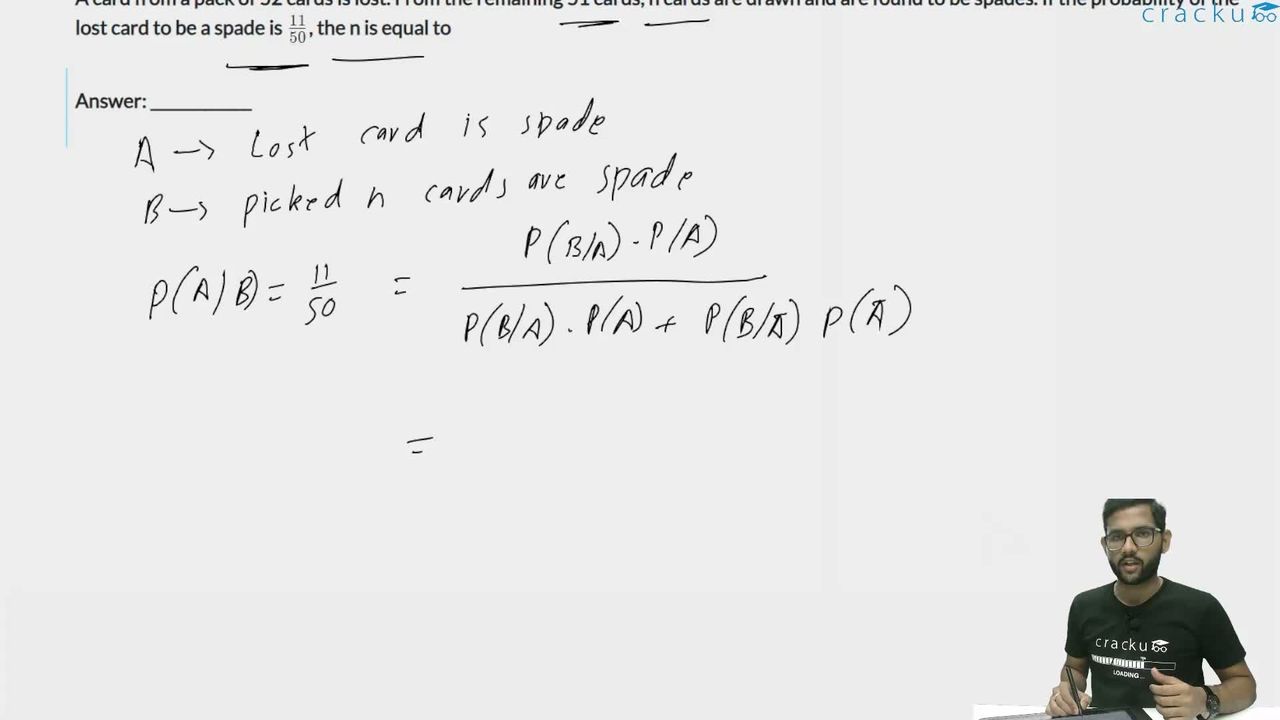
A card from a pack of 52 cards is lost. From the remaining 51 cards, n cards are drawn and are found to be spades. If the probability of the lost card to be a spade is $$\frac{11}{50}$$, the n is equal to
Correct Answer: 2
Let
A : the lost card is a spade,
B : all the $$n$$ cards drawn from the remaining $$51$$ cards are spades.
We are given $$P(A\mid B)=\dfrac{11}{50}$$ and we have to find $$n$$.
First write Bayes’ theorem:
$$P(A\mid B)=\dfrac{P(B\mid A)\,P(A)}{P(B\mid A)\,P(A)+P(B\mid \overline{A})\,P(\overline{A})}\,\,\,-(1)$$
Initial probabilities before any card is lost:
Total spades in a full pack = $$13$$ out of $$52$$.
Hence $$P(A)=\dfrac{13}{52}=\dfrac14$$ and $$P(\overline{A})=\dfrac{39}{52}=\dfrac34$$.
Case 1 (event A happens): the lost card itself is a spade.
Spades left in the remaining $$51$$ cards = $$12$$.
So
$$P(B\mid A)=\dfrac{{}^{12}C_{n}}{{}^{51}C_{n}}\,\,\,-(2)$$
Case 2 (event $$\overline{A}$$ happens): the lost card is not a spade.
Spades left in the remaining $$51$$ cards = $$13$$.
So
$$P(B\mid \overline{A})=\dfrac{{}^{13}C_{n}}{{}^{51}C_{n}}\,\,\,-(3)$$
Substitute $$(2)$$ and $$(3)$$ into $$(1)$$:
$$P(A\mid B)=\dfrac{\displaystyle \frac{{}^{12}C_{n}}{{}^{51}C_{n}}\cdot \frac14}{\displaystyle \frac{{}^{12}C_{n}}{{}^{51}C_{n}}\cdot \frac14+\frac{{}^{13}C_{n}}{{}^{51}C_{n}}\cdot \frac34}$$
Cancel the common factor $${}^{51}C_{n}$$ and multiply numerator and denominator by $$4$$ to simplify:
$$P(A\mid B)=\dfrac{{}^{12}C_{n}}{{}^{12}C_{n}+3\,{}^{13}C_{n}}\,\,\,-(4)$$
The question tells us that $$(4)=\dfrac{11}{50}$$, therefore
$$\dfrac{{}^{12}C_{n}}{{}^{12}C_{n}+3\,{}^{13}C_{n}}=\dfrac{11}{50}$$
Cross-multiply:
$$50\,{}^{12}C_{n}=11\bigl({}^{12}C_{n}+3\,{}^{13}C_{n}\bigr)$$
$$50\,{}^{12}C_{n}=11\,{}^{12}C_{n}+33\,{}^{13}C_{n}$$
Subtract $$11\,{}^{12}C_{n}$$ from both sides:
$$39\,{}^{12}C_{n}=33\,{}^{13}C_{n}$$
Divide by $$3$$:
$$13\,{}^{12}C_{n}=11\,{}^{13}C_{n}\,\,\,-(5)$$
Use the identity relating the two combinations:
$${}^{13}C_{n}=\dfrac{13}{13-n}\,{}^{12}C_{n}$$
Substitute this into $$(5)$$:
$$13\,{}^{12}C_{n}=11\left(\dfrac{13}{13-n}\,{}^{12}C_{n}\right)$$
Cancel the common factor $${}^{12}C_{n}$$:
$$13=\dfrac{143}{13-n}$$
Multiply both sides by $$(13-n)$$:
$$13(13-n)=143$$
$$169-13n=143$$
$$13n=169-143=26$$
$$n=2$$
Hence the number of cards drawn that turned out to be spades is $$n=2$$.
Click on the Email ☝️ to Watch the Video Solution
Create a FREE account and get:
_1.webp)

Educational materials for JEE preparation

Ask our AI anything

AI can make mistakes. Please verify important information.
AI can make mistakes. Please verify important information.


