Sign in
Please select an account to continue using cracku.in
↓ →
Join Our JEE Preparation Group
Prep with like-minded aspirants; Get access to free daily tests and study material.
Two identical concave mirrors each of focal length $$f$$ are facing each other as shown in the schematic diagram. The focal length $$f$$ is much larger than the size of the mirrors. A glass slab of thickness $$t$$ and refractive index $$n_0$$ is kept equidistant from the mirrors and perpendicular to their common principal axis. A monochromatic point light source $$S$$ is embedded at the center of the slab on the principal axis, as shown in the schematic diagram. For the image to be formed on $$S$$ itself, which of the following distances between the two mirrors is/are correct:
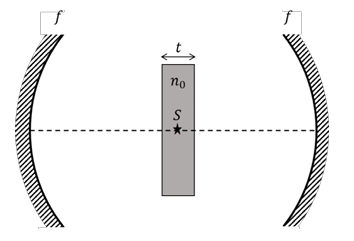
Let the two concave mirrors be $$M_1$$ (left) and $$M_2$$ (right). Both have focal length $$f$$ and face each other.
The glass slab of thickness $$t$$ and refractive index $$n_0$$ is placed symmetrically between the mirrors. The point source $$S$$ lies on the principal axis at the centre of the slab, so its distance from either face of the slab is $$\dfrac{t}{2}$$.
Denote by $$x$$ the air-gap between each mirror and the nearer face of the slab. Hence, total mirror separation is $$D = x + t + x = 2x + t$$ $$-(1)$$
Because light coming from $$S$$ emerges normally from the slab faces (paraxial region), refraction at the faces only changes the apparent position of $$S$$ for an observer in air.
Apparent (optical) distance of $$S$$ from either slab face
$$\;=\; \dfrac{\text{real depth}}{n_0} \;=\; \dfrac{t/2}{n_0}$$ $$-(2)$$
Therefore, for the left mirror $$M_1$$ the object distance (in air, measured from the mirror along the axis) is $$u = -\left[x + \dfrac{t}{2n_0}\right]$$ (negative sign because the object is in front of the concave mirror).
We want the final image, after reflection from $$M_1$$ and re-entry through the slab, to coincide with $$S$$ itself. That will happen if the mirror forms the image at the same optical point as the object, i.e. $$v = u = -\left[x + \dfrac{t}{2n_0}\right]$$.
For a spherical mirror the mirror formula is $$\dfrac{1}{f} = \dfrac{1}{u} + \dfrac{1}{v}$$. Putting $$u = v$$ gives $$\dfrac{1}{f} = \dfrac{2}{u}\;\Longrightarrow\; |u| = 2f$$.
Hence $$x + \dfrac{t}{2n_0} = 2f \quad \Longrightarrow \quad x = 2f - \dfrac{t}{2n_0}$$ $$-(3)$$
Substituting (3) in (1): $$\begin{aligned} D &= 2x + t \\[4pt] &= 2\left(2f - \dfrac{t}{2n_0}\right) + t \\[4pt] &= 4f - \dfrac{t}{n_0} + t \\[4pt] &= 4f + \left(1 - \dfrac{1}{n_0}\right)t \end{aligned}$$
Thus the required separation of the two mirrors is $$\boxed{\,4f + \left(1 - \dfrac{1}{n_0}\right)t\,}$$.
This matches Option A only.
Create a FREE account and get:
Predict your JEE Main percentile, rank & performance in seconds
Educational materials for JEE preparation