
Join Our JEE Preparation Group
Prep with like-minded aspirants; Get access to free daily tests and study material.
Sign in
Please select an account to continue using cracku.in
↓ →
Join Our JEE Preparation Group
Prep with like-minded aspirants; Get access to free daily tests and study material.
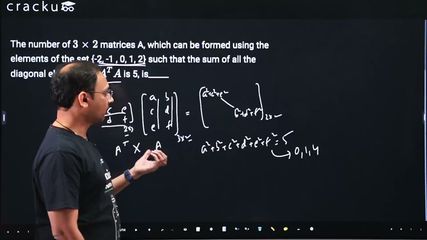
The number of $$3\times 2$$ matrices A, which can be formed using the elements of the set {-2, -1 , 0, 1, 2} such that the sum of all the diagonal elements of $$A^{T}A$$ is 5, is_____
Correct Answer: 312
$$A = \begin{bmatrix}a_{11}&a_{12}\\a_{21}&a_{22}\\a_{31}&a_{32}\end{bmatrix}$$ gives $$\text{tr}(A^T A) = \sum_{k=1}^{3}a_{k1}^2 + \sum_{k=1}^{3}a_{k2}^2 = \sum_{\text{all entries}} a_{ij}^2$$ so the sum of squares of the six entries must equal 5.
Since each entry’s square lies in $$\{0,1,4\}$$ corresponding to entries $$0,\pm1,\pm2$$, letting $$p$$ be the number of zeros, $$q$$ the number of entries with absolute value 1, and $$r$$ the number with absolute value 2 yields $$p+q+r=6$$ and $$q+4r=5,$$ whose only nonnegative solutions are $$r=0,\;q=5,\;p=1$$ and $$r=1,\;q=1,\;p=4$$.
In the first case exactly one entry is 0 and five entries are $$\pm1$$, so there are $$\binom{6}{1}=6$$ ways to choose the zero entry and $$2^5=32$$ sign choices for the others, giving $$6\times32=192$$ matrices.
In the second case one entry is $$\pm2$$, one is $$\pm1$$, and the remaining four are zero, so choosing the $$\pm2$$ position in $$\binom{6}{1}=6$$ ways with 2 sign options and then the $$\pm1$$ position in $$\binom{5}{1}=5$$ ways with 2 sign options yields $$6\times2\times5\times2=120$$ matrices.
Adding these counts gives $$192+120=312$$ and therefore the total number of matrices is $$\boxed{312}$$.
Was this solution helpful?
Click on the Email ☝️ to Watch the Video Solution
Create a FREE account and get:
_1.webp)

Educational materials for JEE preparation

Ask our AI anything

AI can make mistakes. Please verify important information.
AI can make mistakes. Please verify important information.
