
Join Our JEE Preparation Group
Prep with like-minded aspirants; Get access to free daily tests and study material.
Sign in
Please select an account to continue using cracku.in
↓ →
Join Our JEE Preparation Group
Prep with like-minded aspirants; Get access to free daily tests and study material.
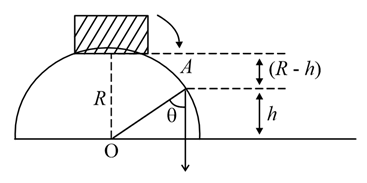
A small block slides down from the top of hemisphere of radius $$R = 3$$ m as shown in the figure. The height $$h$$ at which the block will lose contact with the surface of the sphere is _________ m. (Assume there is no friction between the block and the hemisphere)
Correct Answer: 2
As the block slides from the top of the hemisphere (radius $$R = 3\text{ m}$$) down to a height $$h$$, it drops a vertical distance of $$R - h$$. Equating its loss in potential energy to its gain in kinetic energy gives:
$$mg(R - h) = \frac{1}{2}mv^2 \implies v^2 = 2g(R - h)$$
The centripetal force equation along the radial direction is:
$$mg\cos\theta - N = \frac{mv^2}{R}$$
The block leaves the surface when the normal force drops to zero ($$N = 0$$). Substituting $$\cos\theta = \frac{h}{R}$$ yields:
$$mg\left(\frac{h}{R}\right) = \frac{mv^2}{R} \implies v^2 = gh$$
Equating the two expressions for $$v^2$$:
$$2g(R - h) = gh$$
$$2R - 2h = h \implies 3h = 2R \implies h = \frac{2}{3}R$$
Plugging in $$R = 3\text{ m}$$:
$$h = \frac{2}{3} \times 3 = 2\text{ m}$$
The block will lose contact with the hemisphere at a height of 2 m.
Was this solution helpful?
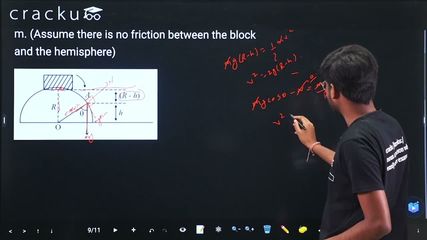
Click on the Email ☝️ to Watch the Video Solution
Create a FREE account and get:
_1.webp)

Educational materials for JEE preparation

Ask our AI anything

AI can make mistakes. Please verify important information.
AI can make mistakes. Please verify important information.
