
Join Our JEE Preparation Group
Prep with like-minded aspirants; Get access to free daily tests and study material.
Sign in
Please select an account to continue using cracku.in
↓ →
Join Our JEE Preparation Group
Prep with like-minded aspirants; Get access to free daily tests and study material.
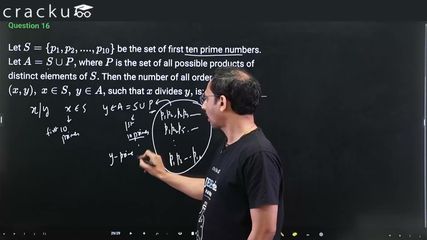
Let $$ S=\{p_1,p_2,....,p_{10}\} $$ be the set of first ten prime numbers. Let $$ A=S\cup P, $$ where $$ P $$ is the set of all possible products of distinct elements of $$ S. $$ Then the number of all ordered pairs $$ (x,y),\; x\in S,\; y\in A, $$ such that $$ x $$ divides $$ y,$$ is: $$ \underline{ \hspace{2cm} } $$
Correct Answer: 5120
S = set of first 10 primes. A = S ∪ P where P = all possible products of distinct elements of S. Find ordered pairs (x,y) where x∈S, y∈A, x|y.
A consists of S (the 10 primes) plus all products of 2 or more distinct primes from S. Total elements in A = $$2^{10} - 1 = 1023$$ (all non-empty subsets of S, each giving a unique product).
For each prime $$p_i \in S$$, count elements y ∈ A such that $$p_i | y$$.
y is a product of a non-empty subset of S. For $$p_i | y$$, the subset must contain $$p_i$$.
Number of such subsets = $$2^9 = 512$$ (choose any subset of the remaining 9 primes, including empty set, and include $$p_i$$).
Total ordered pairs
Each of the 10 primes in S contributes 512 pairs.
Total = $$10 \times 512 = 5120$$
The answer is 5120.
Was this solution helpful?
Click on the Email ☝️ to Watch the Video Solution
Create a FREE account and get:
_1.webp)

Educational materials for JEE preparation

Ask our AI anything

AI can make mistakes. Please verify important information.
AI can make mistakes. Please verify important information.
