
Join Our JEE Preparation Group
Prep with like-minded aspirants; Get access to free daily tests and study material.
Sign in
Please select an account to continue using cracku.in
↓ →
Join Our JEE Preparation Group
Prep with like-minded aspirants; Get access to free daily tests and study material.
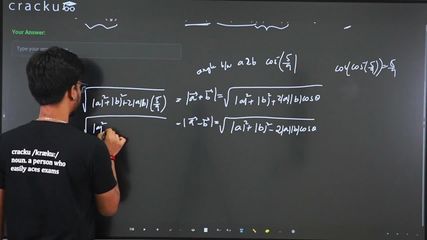
If $$\vec{a}$$ and $$\vec{b}$$ makes an angle $$\cos^{-1}\left(\frac{5}{9}\right)$$ with each other, then for $$|\vec{a} + \vec{b}| = \sqrt{2}|\vec{a} - \vec{b}|$$, $$|\vec{a}| = n|\vec{b}|$$. The integer value of $$n$$ is ____
Correct Answer: 3
The angle between $$\vec{a}$$ and $$\vec{b}$$ is $$\cos^{-1}\left(\frac{5}{9}\right)$$ and $$|\vec{a}+\vec{b}| = \sqrt{2}|\vec{a}-\vec{b}|$$.
Let $$\cos\theta = \frac{5}{9}$$.
From the formulas for the square of the length of the sum and difference of vectors we have:
$$|\vec{a}+\vec{b}|^2 = a^2 + b^2 + 2ab\cos\theta$$
$$|\vec{a}-\vec{b}|^2 = a^2 + b^2 - 2ab\cos\theta$$
Using the given condition we write:
$$a^2 + b^2 + 2ab\cos\theta = 2\bigl(a^2 + b^2 - 2ab\cos\theta\bigr)$$
Expanding the right side gives:
$$a^2 + b^2 + 2ab\cos\theta = 2a^2 + 2b^2 - 4ab\cos\theta$$
Collecting like terms leads to:
$$6ab\cos\theta = a^2 + b^2$$
Substituting $$\cos\theta = \frac{5}{9}$$ into the equation gives:
$$6ab \cdot \frac{5}{9} = a^2 + b^2$$
which simplifies to:
$$\frac{10ab}{3} = a^2 + b^2$$
Assume $$|\vec{a}| = n|\vec{b}|$$ so that $$a = nb$$. Substituting into the last equation yields:
$$\frac{10n b^2}{3} = n^2b^2 + b^2$$
Dividing both sides by $$b^2$$ gives:
$$\frac{10n}{3} = n^2 + 1$$
Rearranging to a standard quadratic form:
$$3n^2 - 10n + 3 = 0$$
Factoring the quadratic leads to:
$$ (3n-1)(n-3) = 0$$
Thus $$n = 3$$ or $$n = \frac{1}{3}$$. Since the integer value is required we choose $$n = 3$$.
The answer is $$\boxed{3}$$.
Was this solution helpful?
Click on the Email ☝️ to Watch the Video Solution
Create a FREE account and get:
_1.webp)

Educational materials for JEE preparation

Ask our AI anything

AI can make mistakes. Please verify important information.
AI can make mistakes. Please verify important information.
