
Join Our JEE Preparation Group
Prep with like-minded aspirants; Get access to free daily tests and study material.
Sign in
Please select an account to continue using cracku.in
↓ →
Join Our JEE Preparation Group
Prep with like-minded aspirants; Get access to free daily tests and study material.
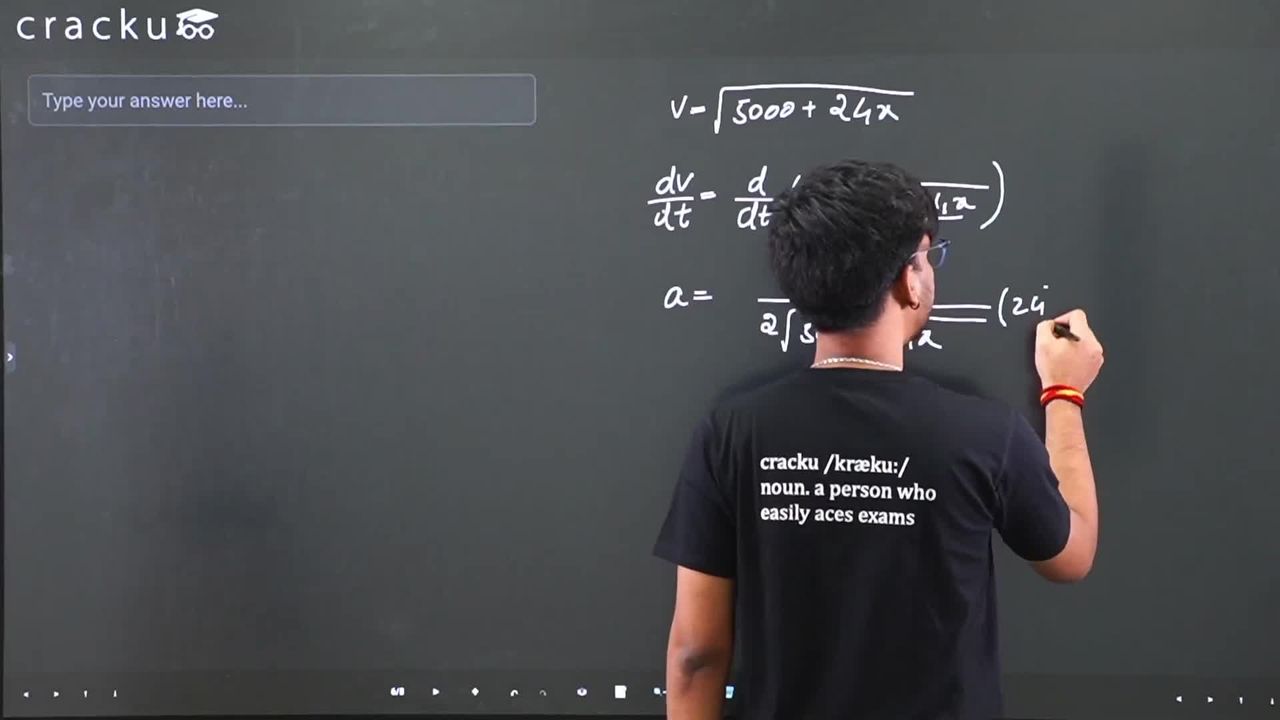
If the velocity of a body related to displacement $$x$$ is given by $$v = \sqrt{5000 + 24x}$$ m s$$^{-1}$$, then the acceleration of the body is _________ m s$$^{-2}$$.
Correct Answer: 12
We are told that the velocity of the body at a displacement $$x$$ from some origin is
$$v \;=\; \sqrt{5000 + 24x}\ \text{m s}^{-1}.$$
To find the acceleration, we recall the basic kinematics relation that connects acceleration $$a$$, velocity $$v$$ and displacement $$x$$. Using the chain rule of calculus, the acceleration can be written as
$$a \;=\; \frac{dv}{dt}\;=\;\frac{dv}{dx}\,\frac{dx}{dt}.$$
But $$\frac{dx}{dt}$$ is simply the velocity $$v$$ itself, so this becomes the well-known result
$$a \;=\; v\,\frac{dv}{dx}.$$
Now we already know $$v$$ as a function of $$x$$, so our next task is to compute the derivative $$\dfrac{dv}{dx}$$ step by step.
First, write the given velocity in exponent form for easier differentiation:
$$v \;=\; (5000 + 24x)^{1/2}.$$
Differentiate with respect to $$x$$ using the power rule $$\dfrac{d}{dx}\,[u^{n}] = n\,u^{\,n-1}\dfrac{du}{dx}$$ where $$u = 5000 + 24x$$ and $$n = \tfrac12\;:$$
$$\frac{dv}{dx} \;=\; \frac12\,(5000 + 24x)^{-1/2}\;\times\;\frac{d}{dx}(5000 + 24x).$$
The derivative of $$5000 + 24x$$ with respect to $$x$$ is simply $$24$$, so
$$\frac{dv}{dx} \;=\; \frac12\,(5000 + 24x)^{-1/2}\;\times\;24.$$
Multiplying the constants gives
$$\frac{dv}{dx} \;=\; 12\,(5000 + 24x)^{-1/2}.$$
Since a negative half-power corresponds to a reciprocal square root, we can rewrite this as
$$\frac{dv}{dx} \;=\; \frac{12}{\sqrt{5000 + 24x}}.$$
We now substitute $$v$$ and $$\dfrac{dv}{dx}$$ into the acceleration formula $$a = v \dfrac{dv}{dx}\,,$$ so
$$a \;=\; \bigl(\sqrt{5000 + 24x}\bigr)\;\times\;\frac{12}{\sqrt{5000 + 24x}}.$$
The square root term in the numerator and the identical square root term in the denominator cancel each other exactly, leaving
$$a \;=\; 12.$$
This result is a constant, independent of $$x$$, and its unit is $$\text{m s}^{-2}$$ because both the velocity and the derivative were in SI units throughout.
So, the answer is $$12$$.
Click on the Email ☝️ to Watch the Video Solution
Create a FREE account and get:
_1.webp)

Educational materials for JEE preparation

Ask our AI anything

AI can make mistakes. Please verify important information.
AI can make mistakes. Please verify important information.


