
Join Our JEE Preparation Group
Prep with like-minded aspirants; Get access to free daily tests and study material.
Sign in
Please select an account to continue using cracku.in
↓ →
Join Our JEE Preparation Group
Prep with like-minded aspirants; Get access to free daily tests and study material.
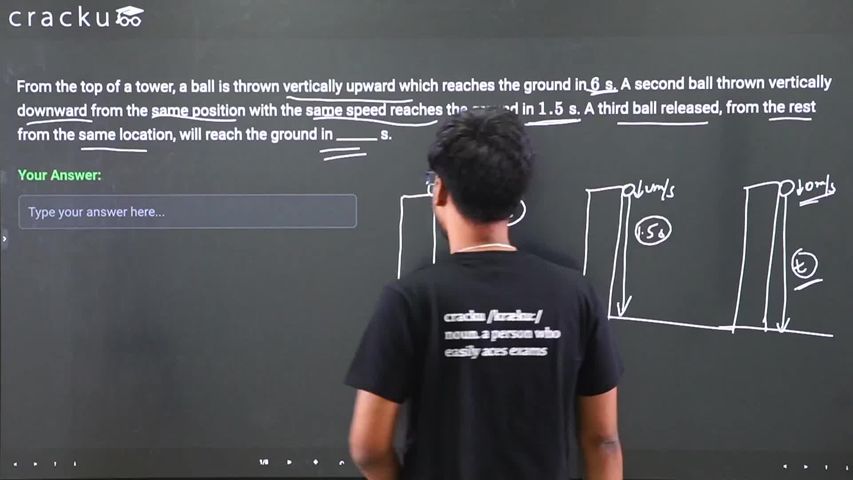
From the top of a tower, a ball is thrown vertically upward which reaches the ground in $$6$$ s. A second ball thrown vertically downward from the same position with the same speed reaches the ground in $$1.5$$ s. A third ball released, from the rest from the same location, will reach the ground in ______ s.
Correct Answer: 3
Let the height of the tower be $$h$$ and the initial speed of the ball be $$u$$. Take downward as positive and the origin at the top of the tower.
Case 1 — Ball thrown vertically upward: Initial velocity = $$-u$$ (upward). Using $$h = -ut_1 + \frac{1}{2}gt_1^2$$:
$$h = -u(6) + \frac{1}{2}g(6)^2 = -6u + 18g \quad \cdots (1)$$
Case 2 — Ball thrown vertically downward: Initial velocity = $$+u$$ (downward). Using $$h = ut_2 + \frac{1}{2}gt_2^2$$:
$$h = u(1.5) + \frac{1}{2}g(1.5)^2 = 1.5u + 1.125g \quad \cdots (2)$$
Case 3 — Ball dropped from rest: Initial velocity = $$0$$. Using $$h = \frac{1}{2}gt_3^2$$:
$$t_3 = \sqrt{\frac{2h}{g}} \quad \cdots (3)$$
Key Relation: There is a well-known result that for this scenario, $$t_3 = \sqrt{t_1 \cdot t_2}$$. Let us derive it.
From equations (1) and (2):
$$-6u + 18g = 1.5u + 1.125g$$
$$18g - 1.125g = 6u + 1.5u$$
$$16.875g = 7.5u$$
$$u = \frac{16.875g}{7.5} = 2.25g$$
Substituting back into equation (2):
$$h = 1.5(2.25g) + 1.125g = 3.375g + 1.125g = 4.5g$$
Now using equation (3):
$$t_3 = \sqrt{\frac{2 \times 4.5g}{g}} = \sqrt{9} = 3 \text{ s}$$
We can verify: $$t_3 = \sqrt{t_1 \times t_2} = \sqrt{6 \times 1.5} = \sqrt{9} = 3$$ s.
The answer is 3 seconds.
Was this solution helpful?
Click on the Email ☝️ to Watch the Video Solution
Create a FREE account and get:
_1.webp)

Educational materials for JEE preparation

Ask our AI anything

AI can make mistakes. Please verify important information.
AI can make mistakes. Please verify important information.
