
Join Our JEE Preparation Group
Prep with like-minded aspirants; Get access to free daily tests and study material.
Sign in
Please select an account to continue using cracku.in
↓ →
Join Our JEE Preparation Group
Prep with like-minded aspirants; Get access to free daily tests and study material.
From a month of 31 days, 3 dates are selected at random. If the probability that these dates are in an increasing A.P. is equal to $$\frac{a}{b}$$, where $$ a , b \in N$$ and $$\gcd(a, b) = 1$$. Then $$a + b$$ is equal to :
Correct Answer: 944
Label the three chosen dates in increasing order as $$a,\,a+d,\,a+2d$$, where $$a\ge 1$$ and the common difference $$d\ge 1$$ is an integer.
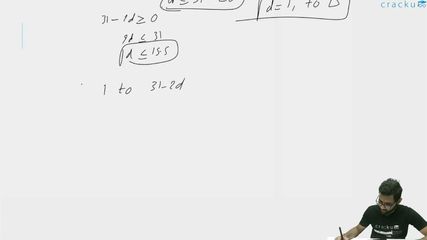
The largest date must not exceed 31, so $$a+2d\le 31 \; \Longrightarrow\; a\le 31-2d$$.
For a fixed $$d$$, the number of admissible first terms $$a$$ is therefore $$31-2d$$.
The common difference can take every integer value from $$1$$ up to $$15$$ because if $$d=16$$ we would need $$a\le -1$$, which is impossible. Thus $$d=1,2,\dots ,15$$.
Total number of favourable arithmetic progressions:
$$N_f=\sum_{d=1}^{15}\bigl(31-2d\bigr)=31\sum_{d=1}^{15}1-2\sum_{d=1}^{15}d.$$
Evaluate the two sums:
$$\sum_{d=1}^{15}1=15,\qquad \sum_{d=1}^{15}d=\frac{15\cdot16}{2}=120.$$
Hence
$$N_f=31\cdot15-2\cdot120=465-240=225.$$
The total number of ways to choose any three distinct dates from the 31-day month is the combination $$\binom{31}{3}$$:
$$N_t=\binom{31}{3}=\frac{31\cdot30\cdot29}{6}=4495.$$
Therefore the required probability is
$$P=\frac{N_f}{N_t}=\frac{225}{4495}.$$
Simplify the fraction. Both numerator and denominator are divisible by $$5$$:
$$\frac{225}{4495}=\frac{45}{899}.$$
The prime factorisation of $$45$$ is $$3^2\cdot5$$, while $$899=29\cdot31$$; no further common factor exists, so the fraction is already in lowest terms with
$$a=45,\; b=899.$$
Finally,
$$a+b=45+899=944.$$
Hence the required value is 944.
Was this solution helpful?
Click on the Email ☝️ to Watch the Video Solution
Create a FREE account and get:
_1.webp)

Educational materials for JEE preparation

Ask our AI anything

AI can make mistakes. Please verify important information.
AI can make mistakes. Please verify important information.


