
Join Our JEE Preparation Group
Prep with like-minded aspirants; Get access to free daily tests and study material.
Sign in
Please select an account to continue using cracku.in
↓ →
Join Our JEE Preparation Group
Prep with like-minded aspirants; Get access to free daily tests and study material.
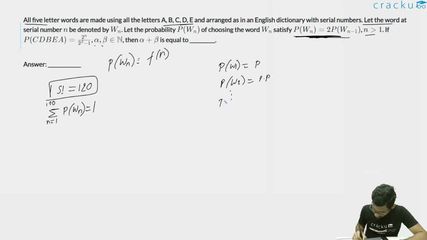
All five letter words are made using all the letters A, B, C, D, E and arranged as in an English dictionary with serial numbers. Let the word at serial number $$n$$ be denoted by $$W_n$$. Let the probability $$P(W_n)$$ of choosing the word $$W_n$$ satisfy $$P(W_n) = 2P(W_{n-1})$$, $$n \gt 1$$. If $$P(CDBEA) = \frac{2^{\alpha}}{2^{\beta} - 1}$$, $$\alpha, \beta \in \mathbb{N}$$, then $$\alpha + \beta$$ is equal to __________.
Correct Answer: 183
There are $$5! = 120$$ different five-letter words that can be formed by using each of the letters A, B, C, D, E exactly once. These words are arranged in ordinary English (lexicographic) order and numbered $$W_1, W_2,\,\dots ,W_{120}$$.
Case 1: Determining the serial number of $$CDBEA$$
Stepwise counting in lexicographic order:
• First letter
A-words: $$4! = 24$$ words (serial numbers $$1\!-\!24$$)
B-words: $$4! = 24$$ words (serial numbers $$25\!-\!48$$)
So words beginning with C start at serial $$49$$.
• First two letters $$C\_x$$ (remaining letters A, B, D, E):
CA-words: $$3! = 6$$ words (serial $$49\!-\!54$$)
CB-words: $$3! = 6$$ words (serial $$55\!-\!60$$)
CD-words therefore start at serial $$61$$.
• First three letters $$CD\_x$$ (remaining letters A, B, E):
CDA-words: $$2! = 2$$ words (serial $$61, 62$$)
CDB-words therefore start at serial $$63$$.
• First four letters $$CDB\_x$$ (remaining letters A, E):
CDBA-word: $$1$$ word (serial $$63$$)
CDBE-words therefore start at serial $$64$$.
The only CDBE-word is $$CDBEA$$ itself, so
$$n = 64.$$
Case 2: Writing the probability model
Let $$P(W_1)=p.$$ Given $$P(W_n)=2P(W_{n-1})$$ for $$n \gt 1$$, the probabilities form a geometric progression: $$P(W_n)=2^{\,n-1}p.$$
The total probability equals $$1$$: $$\sum_{n=1}^{120}P(W_n)=p\sum_{k=0}^{119}2^k =p\,(2^{120}-1)=1.$$ Hence $$p=\frac{1}{2^{120}-1}.$$
Case 3: Probability of the word $$CDBEA$$
The required probability is $$P(CDBEA)=P(W_{64})=2^{64-1}\,p =\frac{2^{63}}{2^{120}-1}.$$
Comparing with $$P(CDBEA)=\dfrac{2^{\alpha}}{2^{\beta}-1}$$ gives $$\alpha = 63,\quad \beta = 120.$$ Therefore, $$\alpha + \beta = 63 + 120 = 183.$$
Final answer: $$183.$$
Was this solution helpful?
Click on the Email ☝️ to Watch the Video Solution
Create a FREE account and get:
_1.webp)

Educational materials for JEE preparation

Ask our AI anything

AI can make mistakes. Please verify important information.
AI can make mistakes. Please verify important information.


