
Join Our JEE Preparation Group
Prep with like-minded aspirants; Get access to free daily tests and study material.
Sign in
Please select an account to continue using cracku.in
↓ →
Join Our JEE Preparation Group
Prep with like-minded aspirants; Get access to free daily tests and study material.
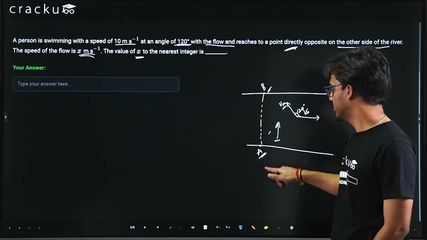
A person is swimming with a speed of 10 m s$$^{-1}$$ at an angle of 120° with the flow and reaches to a point directly opposite on the other side of the river. The speed of the flow is $$x$$ m s$$^{-1}$$. The value of $$x$$ to the nearest integer is ________.
Correct Answer: 5
Let us set up a coordinate system. Let the river flow be along the positive $$x$$-axis with speed $$x \text{ m/s}$$, and let the width of the river be along the $$y$$-axis. The swimmer must reach the point directly opposite, which means the net displacement along the $$x$$-direction must be zero.
The swimmer swims at $$10 \text{ m/s}$$ at an angle of $$120°$$ with the direction of flow (the positive $$x$$-axis). The swimmer's velocity components are: along $$x$$: $$v_{sx} = 10\cos 120° = 10 \times (-\tfrac{1}{2}) = -5 \text{ m/s}$$ (upstream), and along $$y$$: $$v_{sy} = 10\sin 120° = 10 \times \tfrac{\sqrt{3}}{2} = 5\sqrt{3} \text{ m/s}$$ (across the river).
The river flow contributes $$x \text{ m/s}$$ in the positive $$x$$-direction. So the swimmer's net velocity in the $$x$$-direction is $$v_x = x + (-5) = x - 5$$. For the swimmer to reach directly opposite, $$v_x = 0$$, so $$x - 5 = 0$$, giving $$x = 5$$.
The answer is $$\boxed{5}$$.
Was this solution helpful?
Click on the Email ☝️ to Watch the Video Solution
_1.webp)

Educational materials for JEE preparation

Ask our AI anything

AI can make mistakes. Please verify important information.
AI can make mistakes. Please verify important information.