
Join Our JEE Preparation Group
Prep with like-minded aspirants; Get access to free daily tests and study material.
Sign in
Please select an account to continue using cracku.in
↓ →
Join Our JEE Preparation Group
Prep with like-minded aspirants; Get access to free daily tests and study material.
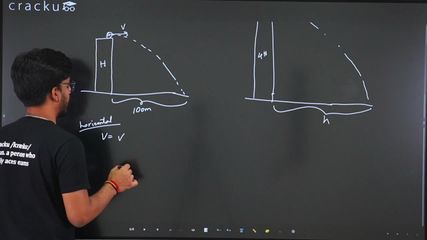
A body of mass $$M$$ thrown horizontally with velocity $$v$$ from the top of the tower of height $$H$$ touches the ground at a distance of 100 m from the foot of the tower. A body of mass $$2M$$ thrown at a velocity $$\frac{v}{2}$$ from the top of the tower of height $$4H$$ will touch the ground at a distance of _____ m.
Correct Answer: 100
We need to find the horizontal range of a body thrown horizontally from a tower, given modified initial conditions.
Recall the formula for horizontal range in projectile motion (horizontal throw). When a body is thrown horizontally with velocity $$v$$ from a height $$H$$, the horizontal range $$R$$ is given by $$R = v \times t$$ where $$t$$ is the time to fall height $$H$$. Since vertical motion is free fall (initial vertical velocity = 0), we have $$H = \frac{1}{2}gt^2 \implies t = \sqrt{\frac{2H}{g}}$$.
Substituting this into the expression for $$R$$ gives $$R = v\sqrt{\frac{2H}{g}}$$, showing that the range does not depend on the mass of the body.
Applying the formula to the first case, where the mass is $$M$$, the horizontal velocity is $$v$$, and the height is $$H$$, and given that the range is 100 m, we get $$100 = v\sqrt{\frac{2H}{g}} \quad \ldots (1)$$.
In the second case, the mass becomes $$2M$$ (which is irrelevant since the range is independent of mass), the horizontal velocity is $$\frac{v}{2}$$, and the height is $$4H$$. Hence, $$R_2 = \frac{v}{2}\sqrt{\frac{2 \times 4H}{g}} = \frac{v}{2}\sqrt{\frac{8H}{g}} = \frac{v}{2} \times 2\sqrt{\frac{2H}{g}} = v\sqrt{\frac{2H}{g}}$$.
From equation (1), $$v\sqrt{\frac{2H}{g}} = 100$$ m, so $$R_2 = 100 \text{ m}$$. The halving of velocity is exactly compensated by the doubling of fall time (due to the four times greater height), resulting in the same horizontal range.
The answer is 100 m.
Was this solution helpful?
Click on the Email ☝️ to Watch the Video Solution
Create a FREE account and get:
_1.webp)

Educational materials for JEE preparation

Ask our AI anything

AI can make mistakes. Please verify important information.
AI can make mistakes. Please verify important information.
