
Join Our JEE Preparation Group
Prep with like-minded aspirants; Get access to free daily tests and study material.
Sign in
Please select an account to continue using cracku.in
↓ →
Join Our JEE Preparation Group
Prep with like-minded aspirants; Get access to free daily tests and study material.
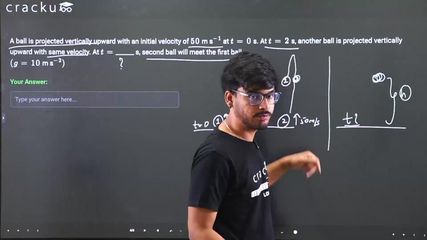
A ball is projected vertically upward with an initial velocity of $$50$$ m s$$^{-1}$$ at $$t = 0$$ s. At $$t = 2$$ s, another ball is projected vertically upward with same velocity. At $$t =$$ ______ s, second ball will meet the first ball.
$$(g = 10$$ m s$$^{-2})$$
Correct Answer: 6
We need to find the time at which the second ball meets the first ball.
Both balls are projected upwards with initial velocity $$u = 50$$ m s$$^{-1}$$ and acceleration due to gravity $$g = 10$$ m s$$^{-2}$$.
The first ball is launched at time $$t = 0$$ s, while the second ball is launched at $$t = 2$$ s.
The height of the first ball at time $$t$$ is given by $$h_1 = ut - \frac{1}{2}gt^2 = 50t - 5t^2$$.
For $$t \ge 2$$, the height of the second ball is $$h_2 = u(t-2) - \frac{1}{2}g(t-2)^2 = 50(t-2) - 5(t-2)^2$$.
The two balls meet when $$h_1 = h_2$$, leading to the equation $$50t - 5t^2 = 50(t-2) - 5(t-2)^2$$.
Expanding the right-hand side gives $$50t - 5t^2 = 50t - 100 - 5(t^2 - 4t + 4) = 50t - 100 - 5t^2 + 20t - 20$$, which simplifies to $$50t - 5t^2 = 70t - 5t^2 - 120$$.
Cancelling like terms and solving for $$t$$ yields $$50t = 70t - 120$$, so $$120 = 20t$$ and hence $$t = 6 \text{ s}$$.
At $$t = 6$$ s, the first ball is at $$h_1 = 50(6) - 5(36) = 300 - 180 = 120$$ m and the second ball is at $$h_2 = 50(4) - 5(16) = 200 - 80 = 120$$ m, confirming they meet at 120 m.
Therefore, the two balls meet at $$t = 6$$ s.
Was this solution helpful?
Click on the Email ☝️ to Watch the Video Solution
Create a FREE account and get:
_1.webp)

Educational materials for JEE preparation

Ask our AI anything

AI can make mistakes. Please verify important information.
AI can make mistakes. Please verify important information.
