
Join Our JEE Preparation Group
Prep with like-minded aspirants; Get access to free daily tests and study material.
Sign in
Please select an account to continue using cracku.in
↓ →
Join Our JEE Preparation Group
Prep with like-minded aspirants; Get access to free daily tests and study material.
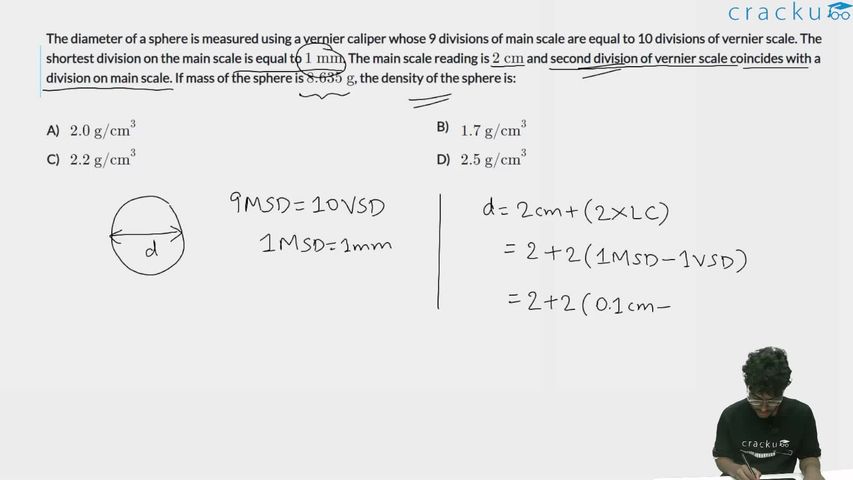
The diameter of a sphere is measured using a vernier caliper whose 9 divisions of main scale are equal to 10 divisions of vernier scale. The shortest division on the main scale is equal to $$1 \text{ mm}$$. The main scale reading is $$2 \text{ cm}$$ and second division of vernier scale coincides with a division on main scale. If mass of the sphere is $$8.635 \text{ g}$$, the density of the sphere is:
We need to find the density of a sphere measured with a vernier caliper.
9 main scale divisions = 10 vernier scale divisions. Smallest main scale division = 1 mm.
$$\text{LC} = 1 \text{ MSD} - 1 \text{ VSD} = 1 - \frac{9}{10} = 0.1 \text{ mm} = 0.01 \text{ cm}$$
Main scale reading = 2 cm. Vernier coincidence = 2nd division.
$$d = \text{MSR} + \text{VSR} \times \text{LC} = 2 + 2 \times 0.01 = 2.02 \text{ cm}$$
Radius: $$r = 1.01$$ cm.
$$V = \frac{4}{3}\pi r^3 = \frac{4}{3} \times \frac{22}{7} \times (1.01)^3$$
$$(1.01)^3 \approx 1.0303$$
$$V = \frac{4}{3} \times 3.1416 \times 1.0303 \approx 4.32 \text{ cm}^3$$
$$\rho = \frac{m}{V} = \frac{8.635}{4.32} \approx 2.0 \text{ g/cm}^3$$
The correct answer is Option (1): 2.0 g/cm$$^3$$.
Was this solution helpful?
Click on the Email ☝️ to Watch the Video Solution
Create a FREE account and get:
_1.webp)

Educational materials for JEE preparation

Ask our AI anything

AI can make mistakes. Please verify important information.
AI can make mistakes. Please verify important information.
