
Join Our JEE Preparation Group
Prep with like-minded aspirants; Get access to free daily tests and study material.
Sign in
Please select an account to continue using cracku.in
↓ →
Join Our JEE Preparation Group
Prep with like-minded aspirants; Get access to free daily tests and study material.
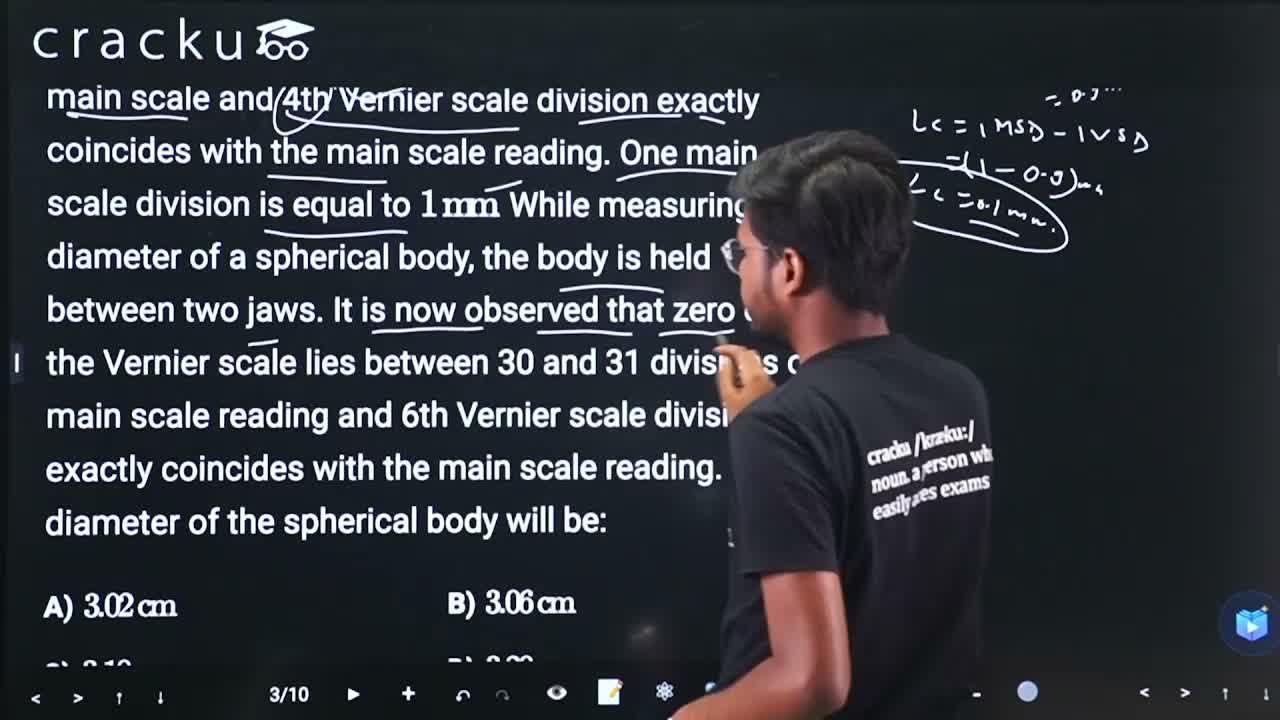
In a Vernier Caliper 10 divisions of Vernier scale is equal to the 9 divisions of main scale. When both jaws of Vernier calipers touch each other, the zero of the Vernier scale is shifted to the left of zero of the main scale and 4th Vernier scale division exactly coincides with the main scale reading. One main scale division is equal to $$1 \text{ mm}$$. While measuring diameter of a spherical body, the body is held between two jaws. It is now observed that zero of the Vernier scale lies between 30 and 31 divisions of main scale reading and 6th Vernier scale division exactly coincides with the main scale reading. The diameter of the spherical body will be:
Given that 10 divisions of the Vernier scale equal 9 divisions of the main scale, and 1 main scale division (MSD) = 1 mm.
Since each Vernier scale division (VSD) is $$\tfrac{9}{10}$$ of an MSD, it follows that $$1 \text{ VSD} = \tfrac{9}{10} \text{ MSD} = 0.9 \text{ mm}.$$ Therefore the least count (LC) is the difference between one MSD and one VSD: $$\text{LC} = 1 \text{ MSD} - 1 \text{ VSD} = 1 - 0.9 = 0.1 \text{ mm}.$$
The zero of the Vernier scale is shifted to the left of the main scale zero, indicating a negative zero error. Because the 4th Vernier division coincides with the main scale, one finds $$\text{Zero error} = -(4 \times \text{LC}) = -(4 \times 0.1) = -0.4 \text{ mm}.$$
The main scale reading (MSR) is 30 mm (since the Vernier zero lies between 30 and 31), and the 6th Vernier division coincides, giving the Vernier scale reading (VSR). Hence $$\text{Observed reading} = \text{MSR} + \text{VSR} \times \text{LC} = 30 + 6 \times 0.1 = 30.6 \text{ mm}.$$
Subtracting the zero error from the observed reading yields the corrected measurement: $$\text{Corrected reading} = \text{Observed reading} - \text{Zero error} = 30.6 - (-0.4) = 30.6 + 0.4 = 31.0 \text{ mm} = 3.10 \text{ cm}.$$ Thus, the diameter of the spherical body is $$3.10 \text{ cm}.$$
The correct answer is Option C.
Was this solution helpful?
Click on the Email ☝️ to Watch the Video Solution
Create a FREE account and get:
_1.webp)

Educational materials for JEE preparation

Ask our AI anything

AI can make mistakes. Please verify important information.
AI can make mistakes. Please verify important information.
