
Join Our JEE Preparation Group
Prep with like-minded aspirants; Get access to free daily tests and study material.
Sign in
Please select an account to continue using cracku.in
↓ →
Join Our JEE Preparation Group
Prep with like-minded aspirants; Get access to free daily tests and study material.
If $$\frac{\pi}{2}\leq x\leq \frac{3\pi}{4}$$, then $$\cos^{-1}\left(\frac{12}{13}\cos x+\frac{5}{13}\sin x\right)$$ is equal to
Rewrite the linear combination of $$\sin x$$ and $$\cos x$$ in the form $$\cos(x-\alpha)$$.
Let $$\alpha$$ satisfy $$\cos\alpha=\frac{12}{13}$$ and $$\sin\alpha=\frac{5}{13}$$.
Because $$\left(\frac{12}{13}\right)^2+\left(\frac{5}{13}\right)^2=\frac{144+25}{169}=1$$, such an $$\alpha$$ exists in the first quadrant.
Using the identity $$\cos(A-B)=\cos A\cos B+\sin A\sin B$$, put $$A=x,\;B=\alpha$$:
$$\cos(x-\alpha)=\cos x\cos\alpha+\sin x\sin\alpha$$
$$\Rightarrow\;\cos(x-\alpha)=\frac{12}{13}\cos x+\frac{5}{13}\sin x$$ $$-(1)$$
Hence $$\frac{12}{13}\cos x+\frac{5}{13}\sin x=\cos(x-\alpha)$$ with $$\alpha=\tan^{-1}\frac{5}{12}$$ $$-(2)$$
Now evaluate the required inverse cosine: $$\cos^{-1}\!\left(\frac{12}{13}\cos x+\frac{5}{13}\sin x\right)=\cos^{-1}\!\left(\cos(x-\alpha)\right)$$ $$-(3)$$
The principal value range of $$\cos^{-1}$$ is $$[\,0,\pi\,]$$. Given $$\dfrac{\pi}{2}\le x\le \dfrac{3\pi}{4}$$ and $$\alpha=\tan^{-1}\dfrac{5}{12}\approx0.394\text{ rad}$$, we obtain $$\frac{\pi}{2}-\alpha\le x-\alpha\le\frac{3\pi}{4}-\alpha$$ $$\Rightarrow\;1.18\text{ rad}\le x-\alpha\le1.96\text{ rad}$$
The interval $$[1.18,1.96]$$ lies completely inside $$[0,\pi]$$, so within this range $$\cos^{-1}\!\left(\cos(y)\right)=y$$ for $$y=x-\alpha$$.
Therefore $$\cos^{-1}\!\left(\frac{12}{13}\cos x+\frac{5}{13}\sin x\right)=x-\alpha$$ $$=x-\tan^{-1}\frac{5}{12}$$.
Hence the correct option is
Option C: $$x-\tan^{-1}\dfrac{5}{12}$$.
Was this solution helpful?
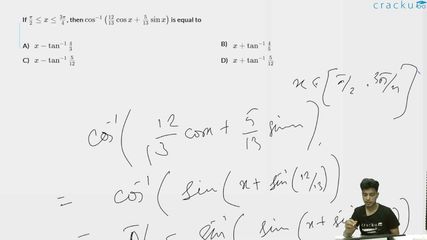
Click on the Email ☝️ to Watch the Video Solution
Create a FREE account and get:
_1.webp)

Educational materials for JEE preparation

Ask our AI anything

AI can make mistakes. Please verify important information.
AI can make mistakes. Please verify important information.
