
Join Our JEE Preparation Group
Prep with like-minded aspirants; Get access to free daily tests and study material.
Sign in
Please select an account to continue using cracku.in
↓ →
Join Our JEE Preparation Group
Prep with like-minded aspirants; Get access to free daily tests and study material.
A thin strip 10 cm long is on a U shaped wire of negligible resistance and it is connected to a spring of spring constant 0.5 N m$$^{-1}$$ (see figure). The assembly is kept in a uniform magnetic field of 0.1 T. If the strip is pulled from its equilibrium position and released, the number of oscillations it performs before its amplitude decreases by a factor of e is N. If the mass of the strip is 50 grams, its resistance 10$$\Omega$$ and air drag negligible, N will be close to:
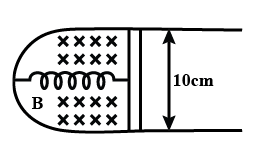
We have a conducting strip of length $$L = 10 \text{ cm}=0.10 \text{ m}$$ sliding on friction-free rails that form a closed circuit of total resistance $$R = 10\ \Omega$$. The strip is free to move along the rails while a uniform magnetic field of magnitude $$B = 0.10\ \text T$$ is directed perpendicular to the plane of the circuit. A light spring of force constant $$k = 0.5\ \text{N m}^{-1}$$ pulls the strip towards its equilibrium position. The mass of the strip is $$m = 50\ \text g = 0.05\ \text{kg}$$. Air drag is negligible, so the only damping is electromagnetic.
Whenever the strip moves with velocity $$v$$, the motional emf produced across its ends is given by Faraday’s law of electromagnetic induction,
$$\varepsilon = B L v.$$
Ohm’s law then gives the induced current,
$$i = \dfrac{\varepsilon}{R}= \dfrac{B L v}{R}.$$ The magnetic force on a current-carrying conductor of length $$L$$ in a field $$B$$ is (in magnitude)
$$F = i L B.$$
Substituting the expression for $$i$$, we obtain
$$F = \left(\dfrac{B L v}{R}\right) L B = \dfrac{B^{2} L^{2}}{R}\,v.$$
This force always opposes the velocity (Lenz’s law), so it behaves exactly like a viscous damping force of the form $$F = -b v$$ with an effective electromagnetic damping coefficient
$$b = \dfrac{B^{2} L^{2}}{R}.$$
Putting in the numerical values,
$$b = \dfrac{(0.10)^2 (0.10)^2}{10} = \dfrac{0.01 \times 0.01}{10} = \dfrac{1.0 \times 10^{-4}}{10} = 1.0 \times 10^{-5}\ \text{N s m}^{-1}.$$
The strip-spring system therefore obeys the equation for a damped harmonic oscillator,
$$m \ddot x + b \dot x + k x = 0.$$
For small damping (which is true here because $$b$$ is very small) the displacement amplitude decays exponentially as
$$A(t)=A_{0}\,e^{-\dfrac{b}{2m}t}.$$
The time constant for the amplitude to fall by a factor of $$e$$ is therefore
$$\tau = \dfrac{2m}{b}.$$
Meanwhile the natural period of oscillation (with weak damping the change in period is negligible) follows from
$$T = 2\pi\sqrt{\dfrac{m}{k}}.$$
The number of oscillations completed in a time $$t$$ is $$n = \dfrac{t}{T}$$, so the number of oscillations completed in one time constant $$\tau$$ is
$$N = \dfrac{\tau}{T} = \dfrac{\dfrac{2m}{b}}{2\pi\sqrt{m/k}} = \dfrac{m}{\pi b}\,\sqrt{\dfrac{k}{m}} = \dfrac{1}{\pi}\,\dfrac{\sqrt{mk}}{b}.$$
Now we substitute every numerical value step by step.
First,
$$\sqrt{mk}= \sqrt{(0.05\ \text{kg})(0.5\ \text{N m}^{-1})} = \sqrt{0.025}\ \text{kg}^{1/2}\text{N}^{1/2}\text{m}^{-1/2} = 0.1581.$$
Next, recalling $$b = 1.0 \times 10^{-5}\ \text{N s m}^{-1}$$, we have
$$N = \dfrac{1}{\pi}\,\dfrac{0.1581}{1.0 \times 10^{-5}} = \dfrac{0.1581}{3.1416 \times 10^{-5}} \approx \dfrac{0.1581}{0.000031416} \approx 5030.$$
Because we merely need a value “close to” the answer, we round to the nearest option offered. $$5030$$ is closest to $$5000.$$
Hence, the correct answer is Option B.
Was this solution helpful?
Create a FREE account and get:
_1.webp)

Educational materials for JEE preparation

Ask our AI anything

AI can make mistakes. Please verify important information.
AI can make mistakes. Please verify important information.
