
Join Our JEE Preparation Group
Prep with like-minded aspirants; Get access to free daily tests and study material.
Sign in
Please select an account to continue using cracku.in
↓ →
Join Our JEE Preparation Group
Prep with like-minded aspirants; Get access to free daily tests and study material.
Two masses $$M_1$$ and $$M_2$$ are tied together at the two ends of a light inextensible string that passes over a frictionless pulley. When the mass $$M_2$$ is twice that of $$M_1$$, the acceleration of the system is $$a_1$$. When the mass $$M_2$$ is thrice that of $$M_1$$, the acceleration of the system is $$a_2$$. The ratio $$\dfrac{a_1}{a_2}$$ will be
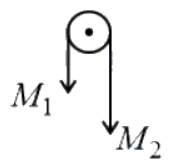
Two masses $$M_1$$ and $$M_2$$ are tied together at the two ends of a light inextensible string that passes over a frictionless pulley. This is known as an Atwood machine. We need to find the ratio $$\dfrac{a_1}{a_2}$$.
Consider two masses $$M_1$$ and $$M_2$$ (where $$M_2 > M_1$$) connected by a string over a frictionless pulley. Let the tension in the string be $$T$$ and the acceleration of the system be $$a$$.
For mass $$M_2$$ moving downward, the net force gives $$M_2 g - T = M_2 a$$. Since mass $$M_1$$ moves upward with the same magnitude of acceleration, we have $$T - M_1 g = M_1 a$$. Adding these equations yields $$M_2 g - M_1 g = (M_1 + M_2) a$$ and therefore $$a = \dfrac{(M_2 - M_1)}{(M_1 + M_2)} \cdot g$$.
Substituting $$M_2 = 2M_1$$ gives $$a_1 = \dfrac{(2M_1 - M_1)}{(M_1 + 2M_1)} \cdot g = \dfrac{M_1}{3M_1} \cdot g = \dfrac{g}{3}$$.
Next, substituting $$M_2 = 3M_1$$ gives $$a_2 = \dfrac{(3M_1 - M_1)}{(M_1 + 3M_1)} \cdot g = \dfrac{2M_1}{4M_1} \cdot g = \dfrac{g}{2}$$.
From this, $$\dfrac{a_1}{a_2} = \dfrac{g/3}{g/2} = \dfrac{g}{3} \times \dfrac{2}{g} = \dfrac{2}{3}$$.
The correct answer is Option B: $$\dfrac{2}{3}$$.
Was this solution helpful?
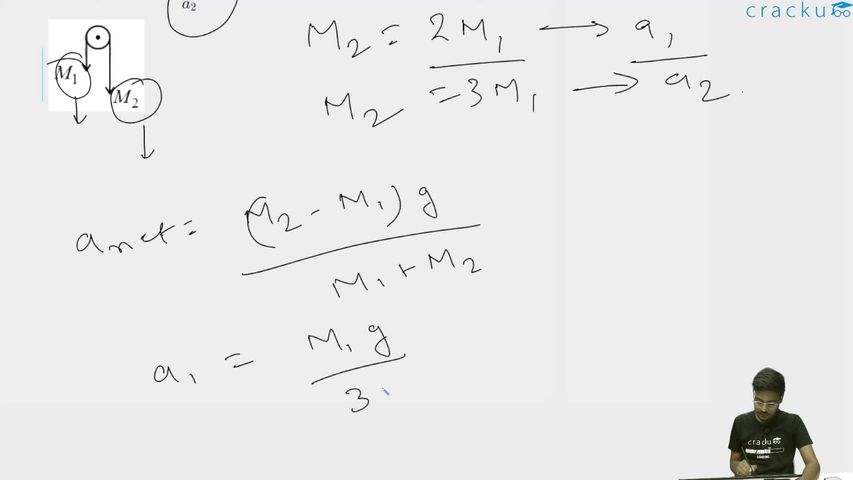
Click on the Email ☝️ to Watch the Video Solution
Create a FREE account and get:
_1.webp)

Educational materials for JEE preparation

Ask our AI anything

AI can make mistakes. Please verify important information.
AI can make mistakes. Please verify important information.
