
Join Our JEE Preparation Group
Prep with like-minded aspirants; Get access to free daily tests and study material.
Sign in
Please select an account to continue using cracku.in
↓ →
Join Our JEE Preparation Group
Prep with like-minded aspirants; Get access to free daily tests and study material.
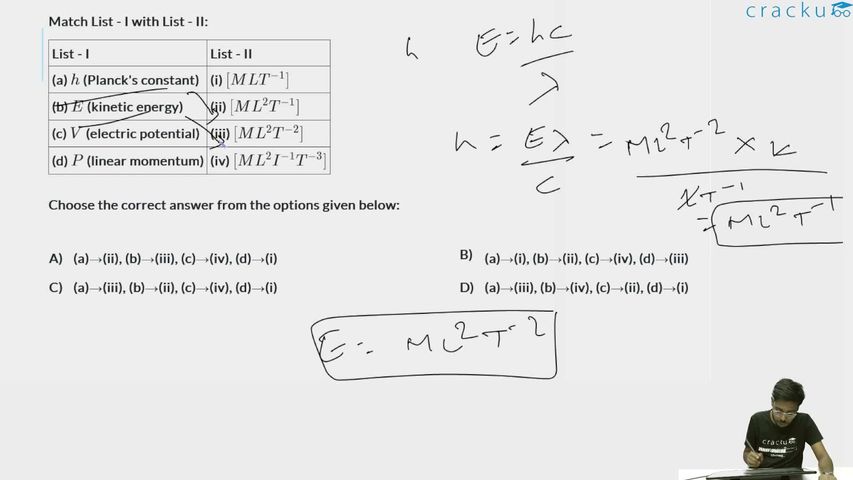
Match List - I with List - II:
| List - I | List - II |
|---|---|
| (a) $$h$$ (Planck's constant) | (i) $$[MLT^{-1}]$$ |
| (b) $$E$$ (kinetic energy) | (ii) $$[ML^2 T^{-1}]$$ |
| (c) $$V$$ (electric potential) | (iii) $$[ML^2 T^{-2}]$$ |
| (d) $$P$$ (linear momentum) | (iv) $$[ML^2 I^{-1} T^{-3}]$$ |
Choose the correct answer from the options given below:
We need to find the dimensional formula for each quantity in List - I and match it with List - II.
Planck's constant $$h$$ has the dimension of energy multiplied by time. Since energy has dimensions $$[ML^2T^{-2}]$$, we get $$[h] = [ML^2T^{-2}] \times [T] = [ML^2T^{-1}]$$, which matches with (ii).
Kinetic energy $$E = \frac{1}{2}mv^2$$ has dimensions $$[M][LT^{-1}]^2 = [ML^2T^{-2}]$$, which matches with (iii).
Electric potential $$V = \frac{W}{q}$$, where work $$W$$ has dimensions $$[ML^2T^{-2}]$$ and charge $$q$$ has dimensions $$[IT]$$. Therefore $$[V] = \frac{[ML^2T^{-2}]}{[IT]} = [ML^2I^{-1}T^{-3}]$$, which matches with (iv).
Linear momentum $$P = mv$$ has dimensions $$[M][LT^{-1}] = [MLT^{-1}]$$, which matches with (i).
Therefore the correct matching is (a)→(ii), (b)→(iii), (c)→(iv), (d)→(i), which corresponds to Option (1).
Was this solution helpful?
Click on the Email ☝️ to Watch the Video Solution
Create a FREE account and get:
_1.webp)

Educational materials for JEE preparation

Ask our AI anything

AI can make mistakes. Please verify important information.
AI can make mistakes. Please verify important information.
