
Join Our JEE Preparation Group
Prep with like-minded aspirants; Get access to free daily tests and study material.
Sign in
Please select an account to continue using cracku.in
↓ →
Join Our JEE Preparation Group
Prep with like-minded aspirants; Get access to free daily tests and study material.
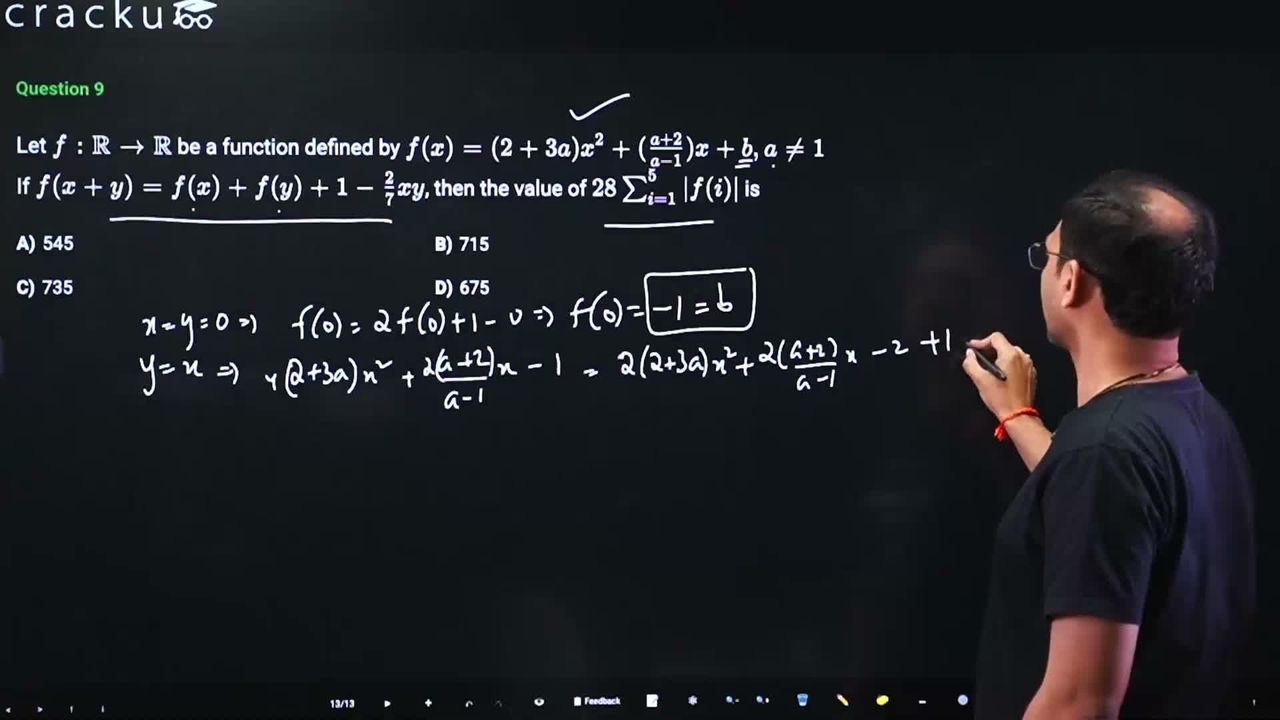
Let $$f:\mathbb{R}\rightarrow \mathbb{R}$$ be a function defined by $$f(x)=(2+3a)x^{2}+(\frac{a+2}{a-1})x+b,a\neq 1$$ If $$f(x+y)=f(x)+f(y)+1-\frac{2}{7}xy$$, then the value of $$28\sum_{i=1}^{5}|f(i)|$$ is
Given $$f(x) = (2+3a)x^2 + \frac{a+2}{a-1}x + b$$ and $$f(x+y) = f(x) + f(y) + 1 - \frac{2}{7}xy$$.
Setting $$x = y = 0$$ yields $$f(0) = 2f(0) + 1$$, which gives $$f(0) = b = -1$$.
Comparing the coefficients of $$xy$$ in the functional equation results in $$2(2+3a) = -\frac{2}{7}$$, so $$a = -\frac{5}{7}$$.
Substituting this value of $$a$$ into the expressions for the coefficients gives $$2+3a = -\frac{1}{7}$$ and $$\frac{a+2}{a-1} = \frac{9/7}{-12/7} = -\frac{3}{4}$$, hence $$f(x) = -\frac{1}{7}x^2 - \frac{3}{4}x - 1$$.
Evaluating this function at integers from 1 to 5 yields $$f(1) = -\frac{1}{7} - \frac{3}{4} - 1 = -\frac{53}{28}$$, $$f(2) = -\frac{4}{7} - \frac{3}{2} - 1 = -\frac{86}{28}$$, $$f(3) = -\frac{9}{7} - \frac{9}{4} - 1 = -\frac{127}{28}$$, $$f(4) = -\frac{16}{7} - 3 - 1 = -\frac{176}{28}$$, and $$f(5) = -\frac{25}{7} - \frac{15}{4} - 1 = -\frac{233}{28}$$. Since all these values are negative, $$\sum|f(i)| = \frac{53+86+127+176+233}{28} = \frac{675}{28}$$.
Multiplying by 28 gives $$28 \times \frac{675}{28} = 675$$.
The correct answer is Option 4: 675.
Was this solution helpful?
Click on the Email ☝️ to Watch the Video Solution
Create a FREE account and get:
_1.webp)

Educational materials for JEE preparation

Ask our AI anything

AI can make mistakes. Please verify important information.
AI can make mistakes. Please verify important information.
