
Join Our JEE Preparation Group
Prep with like-minded aspirants; Get access to free daily tests and study material.
Sign in
Please select an account to continue using cracku.in
↓ →
Join Our JEE Preparation Group
Prep with like-minded aspirants; Get access to free daily tests and study material.
If momentum $$P$$, area $$A$$ and time $$T$$ are taken as fundamental quantities, then the dimensional formula for coefficient of viscosity is
We need to express the coefficient of viscosity in terms of momentum (P), area (A), and time (T) as fundamental quantities.
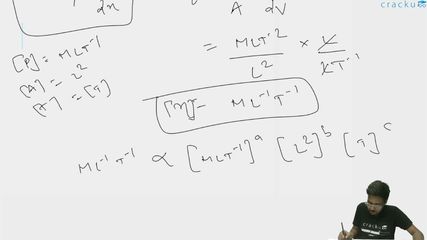
The coefficient of viscosity $$\eta$$ is defined from Newton's law of viscosity: $$F = \eta A \dfrac{dv}{dx}$$, where $$F$$ is the viscous force, $$A$$ is the area, $$dv$$ is the velocity change, and $$dx$$ is the distance perpendicular to the flow. Therefore $$\eta = \dfrac{F}{A} \cdot \dfrac{dx}{dv}$$, and in SI dimensions $$[\eta] = \dfrac{[MLT^{-2}]}{[L^2]} \cdot \dfrac{[L]}{[LT^{-1}]} = [ML^{-1}T^{-1}].$$
The dimensions of momentum, area, and time are respectively $$[P] = [MLT^{-1}]$$, $$[A] = [L^2]$$, and $$[T] = [T].$$
Assuming a relation of the form $$[\eta] = [P]^a [A]^b [T]^c$$, substitution gives $$[ML^{-1}T^{-1}] = [MLT^{-1}]^a \cdot [L^2]^b \cdot [T]^c = [M^a \cdot L^{a+2b} \cdot T^{-a+c}].$$
Equating exponents for each fundamental dimension yields for mass $$a = 1$$, for length $$a + 2b = -1$$ which with $$a = 1$$ gives $$b = -1$$, and for time $$-a + c = -1$$ which with $$a = 1$$ gives $$c = 0$$.
Therefore $$[\eta] = P^1 A^{-1} T^0 = PA^{-1}T^0$$. Verification shows $$PA^{-1}T^0 = [MLT^{-1}][L^{-2}][1] = [ML^{-1}T^{-1}]$$, matching the dimensions of viscosity. Hence, the correct answer is Option A.
Was this solution helpful?
Click on the Email ☝️ to Watch the Video Solution
Create a FREE account and get:
_1.webp)

Educational materials for JEE preparation

Ask our AI anything

AI can make mistakes. Please verify important information.
AI can make mistakes. Please verify important information.
