
Join Our JEE Preparation Group
Prep with like-minded aspirants; Get access to free daily tests and study material.
Sign in
Please select an account to continue using cracku.in
↓ →
Join Our JEE Preparation Group
Prep with like-minded aspirants; Get access to free daily tests and study material.
Given below are two statements :
Statement I : The function $$f:R\rightarrow R $$ defined by $$f(x)=\frac{x}{1+\mid x\mid}$$ is one-one.
Statement II : The function $$f:R\rightarrow R $$ defined by $$f(x)=\frac{x^{2}+4x-30}{x^{2}-8x+18}$$ is many-one.
In the light of the above statements, choose the correct answer from the options given below :
The given function is:
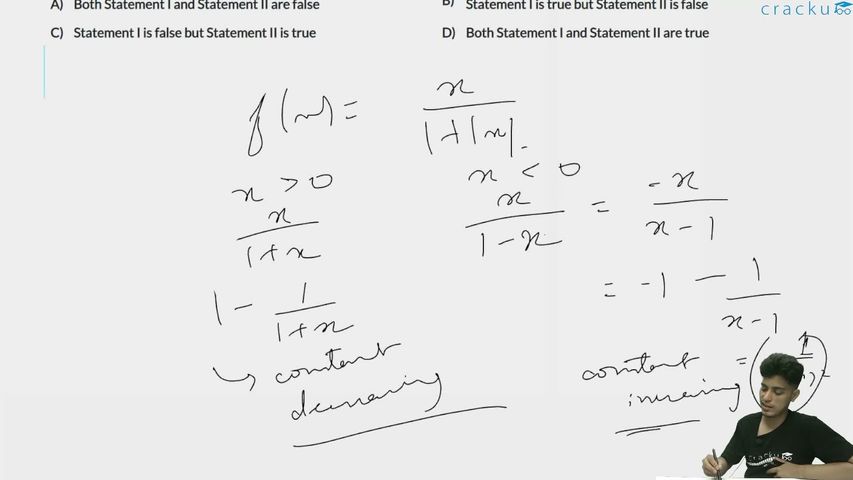
$$f(x) = \frac{x}{1+|x|}$$
To check if it is one-one (injective), we can analyze its behavior in two cases based on the definition of the absolute value |x|:
$$f(x) = \frac{x}{1+x}$$
Differentiating with respect to x:
$$f(x) = \frac{x}{1-x}$$
Differentiating with respect to x:
Since f'(x) > 0 for all $$x \neq 0$$ and the function is continuous at x = 0, the function is strictly increasing across its entire domain $\mathbb{R}$. Any strictly monotonic function is always one-one.
$$f(x) = \frac{x^2+4x-30}{x^2-8x+18}$$
First, let's look at the denominator: $$x^2-8x+18 = (x-4)^2 + 2$$, which is always positive for all real values of x. Thus, the domain is $$\mathbb{R}$$.
Now, let's evaluate the limits of the function at infinity:
$$\lim_{x \to \infty} \frac{x^2+4x-30}{x^2-8x+18} = 1$$
$$\lim_{x \to -\infty} \frac{x^2+4x-30}{x^2-8x+18} = 1$$
Since the function is continuous on $$\mathbb{R}$$ and approaches the same value (1) at both $$+\infty$$ and $$-\infty$$, it must rise/fall and then return toward 1. By the Intermediate Value Theorem (or Rolle's Theorem), the function will output the same value for multiple distinct inputs, which means it is many-one.
Both Statement I and Statement II are true.
Correct Option: D
Was this solution helpful?
Click on the Email ☝️ to Watch the Video Solution
Create a FREE account and get:
_1.webp)

Educational materials for JEE preparation

Ask our AI anything

AI can make mistakes. Please verify important information.
AI can make mistakes. Please verify important information.
