
Join Our JEE Preparation Group
Prep with like-minded aspirants; Get access to free daily tests and study material.
Sign in
Please select an account to continue using cracku.in
↓ →
Join Our JEE Preparation Group
Prep with like-minded aspirants; Get access to free daily tests and study material.
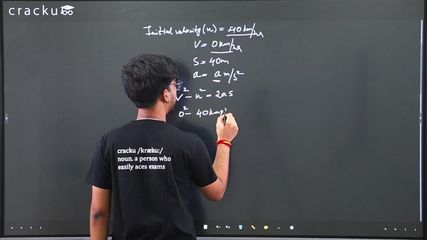
An automobile, travelling at 40 km/h, can be stopped at a distance of 40 m by applying brakes. If the same automobile is travelling at 80 km/h, the minimum stopping distance, in metres, is (assume no skidding):
We begin by recalling the equation of motion for uniformly retarded (decelerated) motion:
$$v^{2}=u^{2}+2as$$
Here, $$u$$ is the initial speed, $$v$$ is the final speed, $$a$$ is the uniform acceleration (negative for braking), and $$s$$ is the displacement during the braking period. For a vehicle that comes to rest, the final speed is zero, that is, $$v=0$$. Substituting $$v=0$$, we obtain
$$0=u^{2}+2as \implies -u^{2}=2as \implies a=-\dfrac{u^{2}}{2s}.$$
The quantity $$|a|=\dfrac{u^{2}}{2s}$$ is the magnitude of the retardation provided by the brakes. Because the same brakes are used in both situations, the magnitude of this retardation remains unchanged.
First we analyse the given data for the initial situation.
Initial speed: $$40\text{ km h}^{-1}.$$
We convert kilometres per hour to metres per second using the relation $$1\text{ km h}^{-1}=\dfrac{5}{18}\text{ m s}^{-1}$$:
$$u_{1}=40\times\dfrac{5}{18}=\dfrac{200}{18}=\dfrac{100}{9}\text{ m s}^{-1}.$$
Stopping distance in this case: $$s_{1}=40\text{ m}.$$
Substituting these values in $$|a|=\dfrac{u^{2}}{2s}$$ gives the magnitude of the retardation:
$$|a|=\dfrac{u_{1}^{2}}{2s_{1}}=\dfrac{\left(\dfrac{100}{9}\right)^{2}}{2\times40} =\dfrac{\dfrac{10000}{81}}{80} =\dfrac{10000}{81\times80} =\dfrac{10000}{6480} =\dfrac{125}{81}\text{ m s}^{-2}.$$
We now consider the second situation, where the automobile’s speed is doubled.
New speed: $$80\text{ km h}^{-1}.$$
Converting again to metres per second:
$$u_{2}=80\times\dfrac{5}{18}=\dfrac{400}{18}=\dfrac{200}{9}\text{ m s}^{-1}.$$
The same brakes give the same magnitude of retardation, $$|a|=\dfrac{125}{81}\text{ m s}^{-2}.$$ Using the formula $$|a|=\dfrac{u^{2}}{2s},$$ but now for the second set of values, we write
$$|a|=\dfrac{u_{2}^{2}}{2s_{2}}.$$
Solving for $$s_{2}$$ gives
$$s_{2}=\dfrac{u_{2}^{2}}{2|a|}.$$
Because $$|a|$$ is the same for both cases, we can avoid recalculation by forming a ratio:
$$\dfrac{s_{2}}{s_{1}}=\dfrac{u_{2}^{2}}{u_{1}^{2}}.$$
Substituting the known speeds,
$$\dfrac{s_{2}}{40}=\dfrac{\left(\dfrac{200}{9}\right)^{2}}{\left(\dfrac{100}{9}\right)^{2}} =\dfrac{200^{2}}{100^{2}} =\dfrac{40000}{10000}=4.$$
Hence
$$s_{2}=4\times40=160\text{ m}.$$
So the automobile will require a minimum stopping distance of $$160\text{ m}$$ when travelling at $$80\text{ km h}^{-1}.$$
Hence, the correct answer is Option B.
Was this solution helpful?
Click on the Email ☝️ to Watch the Video Solution
Create a FREE account and get:
_1.webp)

Educational materials for JEE preparation

Ask our AI anything

AI can make mistakes. Please verify important information.
AI can make mistakes. Please verify important information.
