
Join Our JEE Preparation Group
Prep with like-minded aspirants; Get access to free daily tests and study material.
Sign in
Please select an account to continue using cracku.in
↓ →
Join Our JEE Preparation Group
Prep with like-minded aspirants; Get access to free daily tests and study material.
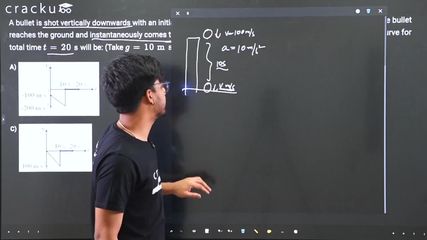
A bullet is shot vertically downwards with an initial velocity of $$100 \text{ m s}^{-1}$$ from a certain height. Within $$10 \text{ s}$$, the bullet reaches the ground and instantaneously comes to rest due to the perfectly inelastic collision. The velocity-time curve for total time $$t = 20 \text{ s}$$ will be: (Take $$g = 10 \text{ m s}^{-2}$$)
We need to identify the correct velocity-time graph for a bullet shot vertically downward. Initially, the velocity $$u = 100$$ m/s downward; taking downward as positive, the velocity after time $$t$$ is given by $$v = u + gt = 100 + 10 \times 10 = 200\text{ m/s}$$ at $$t = 10\text{ s}$$. Thus the velocity increases linearly from 100 m/s to 200 m/s over the first 10 seconds.
At $$t = 10\text{ s}$$ the bullet undergoes a perfectly inelastic collision and instantaneously comes to rest, so the velocity drops from 200 m/s to 0 in a vertical line on the v-t graph. After the collision, from $$t = 10\text{ s}$$ to $$t = 20\text{ s}$$, the bullet remains at rest and hence $$v = 0$$ over this interval.
The v-t curve therefore consists of a straight line with positive slope from (0, 100) to (10, 200), followed by a sudden drop to 0 and then a horizontal line at v = 0 from t = 10 s to t = 20 s. This matches Option A (Option 1), which is the correct answer.
Was this solution helpful?
Click on the Email ☝️ to Watch the Video Solution
Create a FREE account and get:
_1.webp)

Educational materials for JEE preparation

Ask our AI anything

AI can make mistakes. Please verify important information.
AI can make mistakes. Please verify important information.
