
Join Our JEE Preparation Group
Prep with like-minded aspirants; Get access to free daily tests and study material.
Sign in
Please select an account to continue using cracku.in
↓ →
Join Our JEE Preparation Group
Prep with like-minded aspirants; Get access to free daily tests and study material.
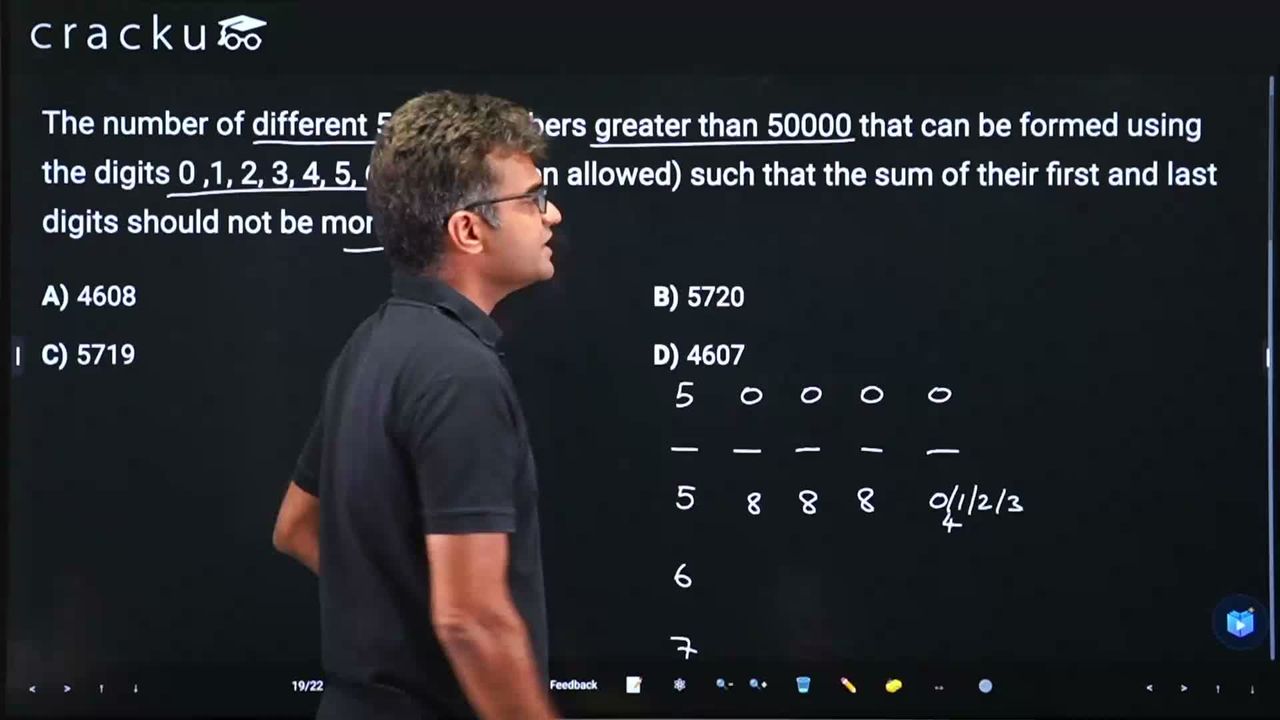
The number of different 5 digit numbers greater than 50000 that can be formed using the digits 0 ,1, 2, 3, 4, 5, 6, 7 (repetition allowed) such that the sum of their first and last digits should not be more than 8 , is
We need 5-digit numbers greater than 50000 using digits 0, 1, 2, 3, 4, 5, 6, 7 (repetition allowed), where the sum of the first and last digits is at most 8.
Since the number must be greater than 50000, the first digit $$a$$ must be 5, 6, or 7.
The middle three digits can each be any of the 8 digits (0 through 7), giving $$8^3 = 512$$ choices.
For the last digit $$e$$, we need $$a + e \leq 8$$ where $$e \in \{0, 1, 2, 3, 4, 5, 6, 7\}$$.
Case 1: $$a = 5$$: then $$e \leq 3$$, so $$e \in \{0, 1, 2, 3\}$$ — 4 choices.
Case 2: $$a = 6$$: then $$e \leq 2$$, so $$e \in \{0, 1, 2\}$$ — 3 choices.
Case 3: $$a = 7$$: then $$e \leq 1$$, so $$e \in \{0, 1\}$$ — 2 choices.
Total number of such 5-digit numbers = $$(4 + 3 + 2) \times 512 = 9 \times 512 = 4608$$
However, the question asks for numbers strictly greater than 50000. The number 50000 itself satisfies all conditions (first digit 5, last digit 0, sum = 5 ≤ 8), but 50000 is not greater than 50000. So we must exclude it.
Therefore, the required count = $$4608 - 1 = 4607$$
Was this solution helpful?
Click on the Email ☝️ to Watch the Video Solution
Create a FREE account and get:
_1.webp)

Educational materials for JEE preparation

Ask our AI anything

AI can make mistakes. Please verify important information.
AI can make mistakes. Please verify important information.
